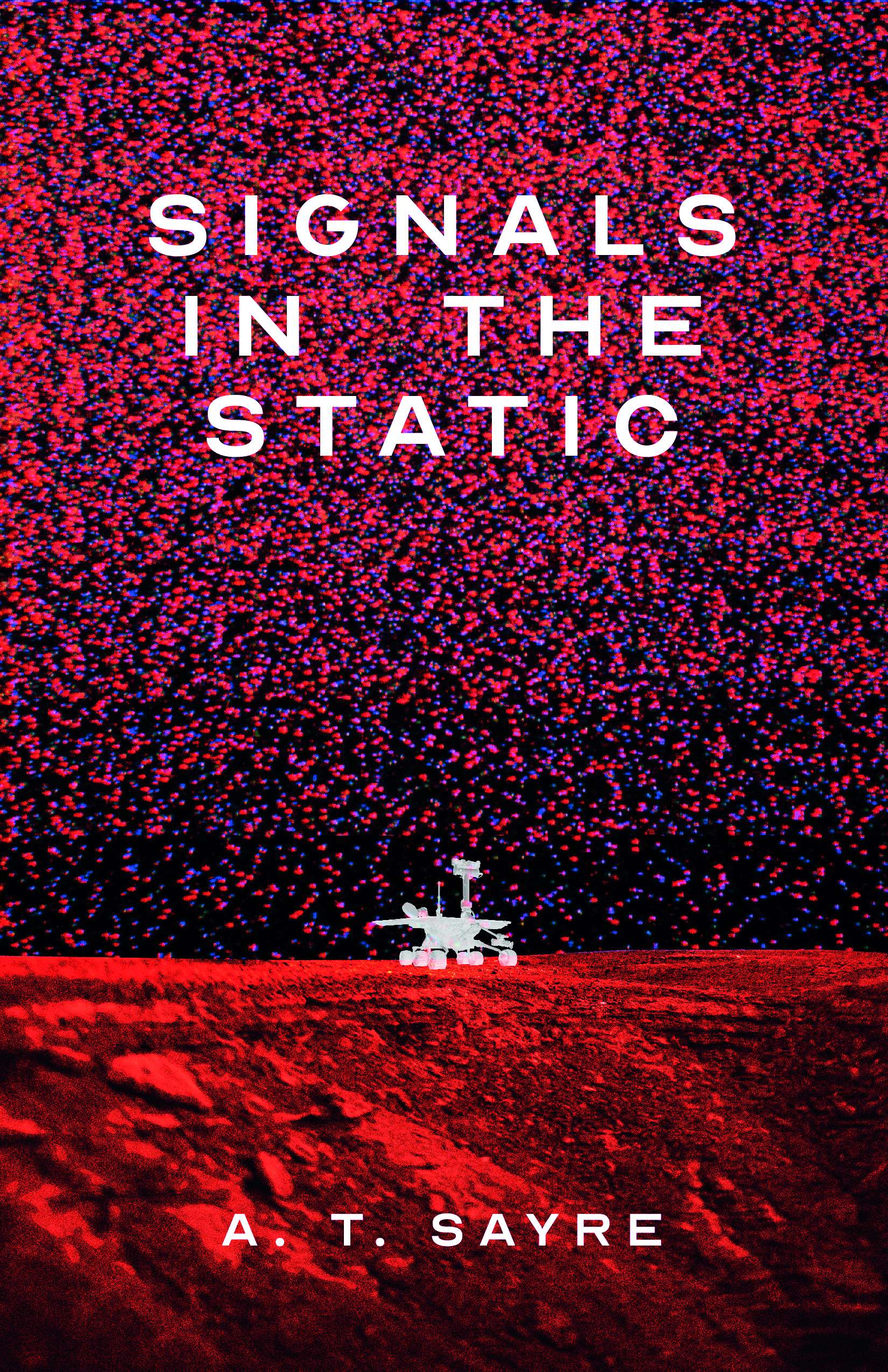

Thanks to AT SAYRE for joining us for this wide-ranging interview and to his publisher for making it possible for you, the reader, to download the book directly from this site: links for that will be nested throughout the piece.
The piece will be broken up into early years, philosophy, and then will go into spoiler ridden deep dives of three stories and one he did not write. So if you’re a spoiler purist, you may want to come back to those sections after reading his book.
Table of Contents
- Early Years
- Philosophy
- Danny, of All People
- Discourse on the Aliens
- The Thing in the Woods
- You may be interested in…
- Your cart is currently empty!
- New in store

Early Years
Lancelot Schaubert — Where’d you grow up?
AT Sayre — I grew up in New Hampshire.
In a town called Hudson, which is right next to Nashua, the second or third-largest city in the state.
Lancelot Schaubert — Oh cool. Did you read a lot of specfic growing up? Or watch or play it or did that come later?
AT Sayre — I was reading from a pretty young age. Maybe as young as five. And not exclusively spec lit, as I was heavily into the Black Stallion series for about a dozen or so books for example. But spec lit was probably more prominent overall. The ones I remember most were The Lord of the Rings trilogy, Narnia, both of which I think I got through by the fourth grade, the first couple Dragonlance series (I am STILL pissed about Sturm Brightblade), Piers Anthony’s various series which I think I read all of, even the obscure ones like his Kirlian Quest series. By the time I was ten or so I’d often be reading three books or more at a time. I’d have them stacked next to my bed, and I would read a chapter in one, then put it at the bottom of the stack and pick up the next one on top and read a chapter of that.
There are a lot of random things in there I remember reading too. I read at least the first two Willy Wonka books, though I blazed through the first one the same night I got my Mom to buy it for me at the mall. Thieves World I think I read too, but for the life of me I can’t remember a thing about them. Robert Aspirin’s Mythadventures series was fun. And Harry Harrison’s Stainless Steel Rat books, which I loved too.
Lancelot Schaubert — What drew you to these stories as opposed to others?
AT Sayre — Well, a lot of it was that they were around. One of my older siblings, either my brother Joe or my sister Martha (they can’t agree who), had left behind a big box of spec lit books, The CS Lewis and Thieves World books, some of the Anthony, but also some Delaney, Frank Herbert, Asimov, LeGuin etc. Plus reading Tolkien was almost a requirement in my family and I think there were like four different sets of that floating around my house.
But I still picked up the ball from there and kept going with it. Developed my own favorites based on some of things I read from that box. I devoured Piers Anthony in my preteens, based on what I’d read in one or two of his books from that box. And I found Dragonlance on my own as well.
What it was in particular that drew me to those books, well, what it was about Piers Anthony that would appeal to a thirteen-year-old boy just about to start puberty…
I don’t mean to sound dismissive of those books. They are imaginative, exciting, with nicely fleshed alien worlds full of amazing alien life. They spark the imagination and get you flexing your inner eye muscles. They were a great starting point for the reading I would do as I got into my teens and moved into more, for lack of a better term, sophisticated fiction.
Lancelot Schaubert — Was there video or radio sectors of the genre that really stuck with you?
AT Sayre — I used to watch classic Doctor Who on PBS with my Mom every Saturday night (I think it was Saturday night) when they stitch together several episodes of a storyline together into one long episode. I didn’t even know it was originally a half-hour episodic show till I was in my thirties!
There was also the original Hitchhiker’s Guide to the Galaxy radio program, as well as the TV series that I loved as a kid too. Both of which I also watched/ listened to with my Mom.
My Dad liked Hitchhiker’s well enough , though was not into Doctor Who. I think actually only me and my Mom were. Maybe my brother Ben too. But my Dad introduced me to 2001 at a young age, which might be the most influential thing to happen to the little lump of clay that was me.
It was the very first movie that he rented when we got our very first VCR. This was 1980 or so, and I was five. Back then you didn’t leave your VCR hooked into your TV all the time, as I believe you had to unhook it from TV antenna to operate it. This was back when the antenna was connected by two copper wires you had to set underneath two screws in on the back of the set, not even a coaxial plug.
Anyway, because it being the very first VCR our family ever had, it took a long time for Dad to figure out how to get it working. Longer than he had expected. And when he finally did get it up and running it was already something like 9PM. But he started the movie anyway, and I remember lying on the floor in the living room on a big throw pillow as the movie started with that Strauss crescendo and the planets in alignment. It was really something, I had never seen anything like it before in my life. But I was still five years old, and it was already late when it started, so I passed long before the movie finished.
But the next day, instead of going out to play in the sun, I made my Dad rehook the VCR up so I could finish watching 2001 that afternoon. My brothers thought I was crazy, and even my Dad was a little put back by that, but I didn’t care. That film seemed to affect me from the very first moment. I have no idea how many times I have seen it since. But it has always been with me.
Lancelot Schaubert — What’s your favorite part about that film?
AT Sayre — I don’t know if I can say. The film has been in my head for almost 45 years now, and probably has shaped my brain more than almost anything else. In a way it might be a metric I judge a lot of what I read or watch by. The aesthetics, the thematic depth of it are still mindblowing to me. I suppose perhaps it could be the way it shows what is possible in spec fiction, that a story can be about deeply philosophical and meaningful ideas and not just cool gadgets, exotic aliens, and flashy spaceships shooting lasers at each other for no other reason than they are cool gadgets, exotic aliens, and flashy spaceships shooting lasers at each other.

Signals in the Static ebook by AT Sayre
Sayre’s debut collection showcases the author’s science fiction tales of determined robots, alien diplomacy, and space exploration; dark fantastical stories where natural laws are broken and monsters are revealed to wear a human face. “Fascinating, mind-expanding speculative fiction tales that explore life from the personal to the cosmic, and from the grotesque to the sublime.”…
Philosophy
Lancelot Schaubert — Do you like philosophy?
AT Sayre — Very much. I got a minor in philosophy in college—which actually happened inadvertently. When I had time in my course schedule I would take classes that looked interesting but had nothing to with my film production degree. These were mostly literature or philosophy classes. By the time I was a senior, I had taken so many philosophy classes that I was one class away from getting the minor, which I hadn’t realized until I looked.
Philosophy to me is a key to understanding life and the world, and how to shape a purpose in it. Obviously, as that is its stated goal. It can get bogged down in pedantic arguments that in the end are little more than word games, and many of the most prominent thinkers in history quite frankly couldn’t construct a coherent sentence if their lives depended on it, but much of how I view the world and what I write about comes directly from the philosophy I read when I was young.
Lancelot Schaubert — Oh absolutely. Who are your favorite philosophers?
AT Sayre — Being a subruban kid with goth poet adjacent style, the existentialists, of course, are essential. Which means Camus and Sartre, but also many of their precursors, like Nietzche, Kierkegaardard, Edmund Husserl, and Immanuel Kant. Martin Heidegger has his moments as well, even though he is the poster boy for needlessly incoherent writing and kind of a nazi to boot. Others here and there, like Martin Buber. I actually riffed on a well-known passage of his in one of my stories, Broken, that nobody seems to have noticed. Showing that ‘well known’ is a subjective term.
I have many stories that are riffs on things I read in philosophical works. Some more overtly than others. My story Rover is pretty openly existential, at least that was the intention. A science fiction story that I hope would make Camus proud.
Lancelot Schaubert — Kierkegaard’s an interesting one in that mix, particularly where he responds to levelling — sort of the proto-nihilism. Kant too, particularly with the universal imperative. Have you teased out contingency, particularly the ontological causality? The fifth cause? And what about formal and final causality?
And by teased out, I mean more in your fiction?
(Though happy to talk otherwise as well).
AT Sayre — Settle down there. It was only a minor in philosophy.
Lancelot Schaubert — Haha.
It’s no big deal either way. I’m just always fascinated by it.
AT Sayre — It is interesting. And I believe a lot more applicable to life than generally assumed.
Lancelot Schaubert — Oh for sure.
Particularly in a science fiction and fantasy environment, we tend to focus on other causes. So our computers right now, for instance, have their material causes — plastic, precious metals, electrons. But, to borrow the existentialists, a material cause doesn’t explain its existence per se right now. And there’s efficient causes — say the factories, the delivery channel, the mines. But an efficient cause isn’t actively present right now. And formal causes, one of whom for mine was Steve Jobs, but of course Steve Jobs is dead. And of course the final cause of my typing, but the purpose of my typing doesn’t give the computer permission to exist. So none of these — the material components of the computer, the supply chain (however infinite up to a pleonastic fallacy), the designers of it, nor its purpose — explain why, right now, it exists. It has being. That’s its ontological cause. That’s the one that gives me wonder. The ultimate explanation of what is clearly, at every point, a contingent reality we find ourselves immersed inside. That everything we encounter is contingent — that nothing contains the cause of its own being.
I’m curious about that wonder: how have you explored it?
If not, that’s totally cool, I can move on to a different question.
AT Sayre — I think the way you are talking about being above is not something I struggle with, its something I take as a given. Nothing contains the cause of its own being, or as I would put it, nothing has objective meaning, and that’s fine. Things just are. Not a problem. It’s still there whether I can universally quantify its value or not. All meaning and purpose is subjective. What meaning my computer has to me, is what use I have for it. Same with the glass of water on my desk, the coaster the glass rests on, and the desk. Any of these could have different meanings to someone else, but that’s them, not me. As far as other people, well, it gets more complicated there, because while using such a utilitarian way of seeing others might make a certain logical sense, it also makes you a sociopath.
But still, I can’t worry about some universal grand purpose or design to anything or anyone because there isn’t one, and worrying too much about that fact leads to solipsism or nihilism.
I go for a more individual, personal exploration of purpose or meaning. What MY meaning is. Or what the characters I create decide or struggle to decide on their own personal meaning or purpose.
Lancelot Schaubert — Yes, it think it would make you a sociopath. I agree with that. Or worse — one with power. That’s true nihilism to me, subjectivism writ large. But I do see the intimate value in being a true individual — most of the renaissance men had that in their bones, Francis as the morningstar of the Medieval transition towards the post Christian era. Whatever else that man was, it’s easy enough to say there was none other like him.
AT Sayre — I have many stories that are riffs on things I read in philosophical works. Some more overtly than others. My story Rover is pretty openly existential, at least that was the intention. A science fiction story that I hope would make Camus proud.
Lancelot Schaubert — I might also add that the “logical” sense is only one mode of logic. Other systems might call that logic “nonsense.” And so not only utlitarianism applied to human life, but animal life, plant life, ameoba life, even the life of said cup coaster might not even apply. Things do refer to things beyond them and not merely on an individual level. We are, after all, conducting this conversation quite civilly, normally, understadibly, and meaningfully in that irridicibly complex organism known as “language.” Our signs, in other words, do have mutual signifiers and signifieds.
What was the Buber passage? And the Camus reference in this one?
AT Sayre — The Buber passage is in the story Broken, where one of the robots sitting at the table in the shop starts rambling about a tree they perceive in their mind. It’s a straight up riff on a passage from I and Thou. I read it now, and what exactly I was doing there is not as clear to me anymore. I first wrote that story over twenty years ago when I was in college. When I was actually studying Martin Buber in one of my philosophy classes, actually.
And the Camus reference was not any one particular story, but just in general with what I write and what I think. Out of all the philosophers he might be the one I feel attached to the most. I mean I’ve grabbed things from many of them to incorporate into my own ideas, Kant’s noumenal/ phenomenal distinction, Kierkegaard’s Leap of Faith, Sartre’s description of bad faith. But I kinda ascribe to Camus’ The Myth of Sisyphus completely.
Lancelot Schaubert — Do you have a quote? I think some of my readers might find that fascinating.
AT Sayre — The Buber quote, or what I did with it?
Lancelot Schaubert — ¿Por que no los dos? If you feel like sharing what you did, cool too.
AT Sayre — The Buber thing is not a quote, it’s a long passage from the book, one of the main points of it, if I am remembering it correctly.
“I consider a tree.
― Martin Buber, I and Thou
I can look on it as a picture: stiff column in a shock of light, or splash of green shot with the delicate blue and silver of the background.
I can perceive it as movement: flowing veins on clinging, pressing pith, suck of the roots, breathing of the leaves, ceaseless commerce with earth and air—and the obscure growth itself.
I can classify it in a species and study it as a type in its structure and mode of life.
I can subdue its actual presence and form so sternly that I recognise it only as an expression of law — of the laws in accordance with which a constant opposition of forces is continually adjusted, or of those in accordance with which the component substances mingle and separate.
I can dissipate it and perpetuate it in number, in pure numerical relation.
In all this the tree remains my object, occupies space and time, and has its nature and constitution.
It can, however, also come about, if I have both will and grace, that in considering the tree I become bound up in relation to it. The tree is now no longer It. I have been seized by the power of exclusiveness.
To effect this it is not necessary for me to give up any of the ways in which I consider the tree. There is nothing from which I would have to turn my eyes away in order to see, and no knowledge that I would have to forget. Rather is everything, picture and movement, species and type, law and number, indivisibly united in this event.
Everything belonging to the tree is in this: its form and structure, its colours and chemical composition, its intercourse with the elements and with the stars, are all present in a single whole.
The tree is no impression, no play of my imagination, no value depending on my mood; but it is bodied over against me and has to do with me, as I with it — only in a different way.
Let no attempt be made to sap the strength from the meaning of the relation: relation is mutual.”
Lancelot Schaubert — Okay yeah that’s good. And I think that’s what I was getting at with the life of a thing: mutual relationship precludes utilitarianism.
Happy to see your passage too, if you want. No big if not.
AT Sayre — Mine is in a story in the collection I sent you, but not something I can link to, but here it is pasted in from the book:
“I perceive a tree,” it said. “I perceive a tree sitting in the middle of a field. The tree is one point two-one-zero-three- four meters off the approximate center of the field. I can perceive and see each and every one of its branches and every leaf of the thousands the tree has. I can count the leaves. There are one hundred thirty-five thousand four hundred sixty-eight leaves on the tree. I can categorize the leaves into two hundred fifty different shades of green. I can measure the height and width of the tree. It is exactly twelve point one-zero-two-six-five-three meters tall. It is two point seven- eight-five-two-zero-four meters in circumference. I can measure its growth. The tree is growing at two point nine- eight millimeters per day. I can scan the tree with infrared to see that the biological processes are functioning within acceptable parameters for continued life. I can detect the presence of one thousand seventy-nine different biological lifeforms inside the tree. I can classify forty-seven different genera of those lifeforms. I can determine the age of the tree. The tree is twenty years, three months, two days, and three hours old. I can estimate the continued lifespan of the tree. The tree will live another one hundred seventy years if all conditions stay within relative parameters. I perceive this tree in my mind. I have a tree in my mind…” I tried directing my question to that one, seeing as how it obviously had its vocals connected. “SR, when is the repairman coming back?”
The SR turned to look up at me slowly. “I have a tree in my mind,” it told me. “It is growing by leaps and bounds inside of my skull. It already has doubled its size and processor space in my brain. Soon it will be too large for my skull to hold. I will need to get a new skull to hold it as it uses the nutrients from the Earth in my head to grow even larger. If I do not get a larger skull, it will make my head explode into ten million fifty pieces in three years, seven months, three days, two hours. Its growth can be charted with the following formula….”
— from Signals in the Static
Lancelot Schaubert — Regarding Sisyphus: imagining him happy?
AT Sayre — When did I say that about Sisyphus? I mean, that is kind of what Camus said about him at the end of his essay, but did I say that here?
Lancelot Schaubert — You said: ” I kinda ascribe to Camus’ The Myth of Sisyphus completely.” And I was trying to tease out what you meant by “ascribe completely.”
AT Sayre —As in as far as philosophical arguments, its the one I agree wtih the most.
Lancelot Schaubert — So quick question on Camus and we’ll ca-move on. Camus would have us believe that we are to ‘imagine Sysiphus happy,’ but how are we to consider Sysiphus at all, unless we first consider Zeus? Without the gods, there is no Sysiphus, no task to be endured—only a lone boulder at the foot of a nameless mountain. Are we both Sysiphus and Zeus?
AT Sayre —I don’t see how Zeus or any of the rest of Greek mythology is relevant here. The Myth of Sisyphus is an allegory Camus is using to make his point about the lack of objective meaning in life, holding him up as a contrast to human existence. He’s happy because he is the only person to have the one thing the rest of us desperately want but will never have: objective certainty of purpose.
How he got it is not the point. It doesn’t matter if it was from Zeus, Hera, or a ballot initiative. He has it.
Lancelot Schaubert — And yet, in the Metamorphosis by Ovid, in the Orpheus and Eurydice chapter, Orpheus’s song to the god of death so moves Sisyphus that inque tuo sedisti, Sisyphe, saxo — “you sat, Sisyphus, on your rock.” It stops him dead in the midst of his objective certainy of purpose: the song of love in the teeth of death makes even Sisyphus doubt. Perhaps there is a purpose behind his purpose? One that only a love song can charm him beyond death? But what do I know? I’m only teasing out wonder here…
What are some of the stories about? What will the average reader like?
AT Sayre — The average reader will like all of them.
Lancelot Schaubert — HA! My man.
Awesome.
Any specific bits or speculations you’re proud of? That you feel move the spec fic conversation forwards?
AT Sayre — There are a lot of things in the stories that I am proud of, but more from a personal achievment standpoint than any kind of ‘fostering progress’ angle. That’s not really my goal. If something I write leads to some kind of positive progress, neato, but that’s not why I do this. But if I really wanted to effect change I’d run for office. Or at least work to get someone else elected.
Lancelot Schaubert — Are you working on any longform work?
AT Sayre — The things I am proud of in a lot of these stories is some challenge I set for myself in the nature of a given story. Something about the structure, the theme, the delivery, or complicated stlye.
Lancelot Schaubert — Do you work like that often? Set some creative limit and try to push for something you haven’t done before? I tend to do that, is why I ask. Will Do, which sold awhile back, was all in the future tense. Give Me Your Tired grew out of a Mary Robinette Kowal description exercise.
AT Sayre — When its warranted. When it helps with expressing the idea. You have to be careful not to do it just for the sake of doing it, because then it becomes a gimmick or a cheap trick. Sometimes, for the idea you’re trying to express, the conventional is the way to go. Something like I’m Not Robert is a farily straightforward first person story, told with little to no bells or whistles. The Missionaries is thrid person, also with little to nothing unconventional in its delivery. In both of those there are what at least I think are interesting ideas being expressed, but it’s done in a fairly common straightforward way. To do otherwise would have been unnecesarily distracting. But then are other stories where something unconventional was called for, like The Angles, where the POV of the protagonist is jumping around to random points in time without so much as a line break to signify it. That was absolutely necessary for the story I was telling. Or stories like The Spot and Transmit Soldier both of which are second person stories, something I love to play with when the idea warrants it, which in both cases I thought it did.
Lancelot Schaubert — Do you have any favorite second person stories that you’ve read? I find it a curious medium, much more common in the ancient world, breakrooms, and certain gaming environs
AT Sayre — There’s always Theodore Sturgeon’s classic The Man Who Lost the Sea which is just beautiful writing. And I remember the first time I cam across it, in Jay McInnery’s Bright Lights, Big City where he managed to pull it off for a whole novel, which is pretty impressive. Second person is not easy to write in, and oftentimes will fall apart into a poorly masked first person story, which I think I’ve seen more often than it being used sucessfully. A lot of readers will balk at it, too, and I have had editors at magazines tell me how much they hated it. I still remember the editor at a particular semi pro mag rejecting The Spot with a peronsal letter not talking about the story at all but with a thick paragraph long rant about why second person is bad, and why I should never write in second person ever.
Lancelot Schaubert — Ha! The gall of that rant.
AT Sayre — But I like second person. Like reading it, when done right, and like writing in it, when warranted. It can give you an angle on an idea that you can’t get from first or third person.
Lancelot Schaubert — Yeah I do too. I honestly like any style done well. I’m impartial to style, genre, whatever. I just want to see the magic trick pulled off. The bigger the attempt, the more I want to see it work. I’m only ever disappointed when they didn’t quite pull off whatever they were intending.
Any other weird narrative styles you’ve enjoyed? Or that have made you think?
I talked a bit about experimental fiction with Dave King awhile back.
That was mostly about the various presences of the author / character / reader relationship.
AT Sayre — I’ve always been captivated by the direct, almost meta, conversational style that writers like Kurt Vonnegut and on occasion Harlan Ellison and Tom Robbins among others have used. Sort of a modern version of the ‘dear reader’ schtick. Putting the writer in the story, or just having these page long covnersations with the reader in the middle of your story. It’s so wild. I have tried it a little bit at various times, but so far I don’t think I’ve ever come close to succeeding at it more than once. I think it’s just one of those things I’ll never be able to really do, as much as I enjoy it when others do it.
Lancelot Schaubert — Oh for sure. Me too.
Nabokov does it too. King.
Lewis.
It takes a certain philosophical bend that Dorothy Sayers captures in Mind of the Maker, but when done well it’s amazing. I think King got closest, personally, though the end of Pnin by Nabokov has the best moment of all.
Have you used court transcripts or text convos? Anything weird like that?
I’m thinking of Dostoevsky’s Novel in Nine Letters
AT Sayre — Nah, the best is Vonnegut’s Breakfast of Champions. He puts himself in the book, talknig to his recurring fictional version of himself, in a book full of so many non sequitors (with pictures) that I don’t think it’d even be novella length if you took them all out.
Lancelot Schaubert — Oh I love that moment, yes.
AT Sayre — Never tried anything liek that. Nothing wrogn with those, but I’ve never had an idea they’d be good for.
Lancelot Schaubert — Gotcha.
What else should I be asking that I haven’t? Where am I ignorant of my ignorance on your craft, your passions, your curiosity?
AT Sayre — Well, some talk about some of the stories in particular. Though I gather we’d need to take a pause on all this till you’ve had a chance to read some of the book. Which is fine if that’s what you’d want to do.
Signals in the Static ebook by AT Sayre
Sayre’s debut collection showcases the author’s science fiction tales of determined robots, alien diplomacy, and space exploration; dark fantastical stories where natural laws are broken and monsters are revealed to wear a human face. “Fascinating, mind-expanding speculative fiction tales that explore life from the personal to the cosmic, and from the grotesque to the sublime.”…
Danny, of All People
Lancelot Schaubert — Let’s talk Danny Mullins.
What was the inspiration for that? It’s both philosophical and something like an elaborate shaggy dog joke.
AT Sayre — Danny, of All People is structured like a joke. And I suppose at least a little bit I was trying to be funny at the end. There are a line or two in it that make me grin, like the ‘part-time keyboardist in an indie band.’ But it is not really meant to be a ‘humorous’ story. More cute, I guess. The setting was inspired by years of going to coffeehouses, hanging out there, and interacting with people. Every character in that short story is someone specifically I know from one place or another I’ve loitered at in my life, Danny included. And the locale is a specific little place I was going to at the time I wrote this story. It’s one of two stories I’ve written in that location, actually (the other not being in this collection), which is odd because to be honest as far as coffeehouses/ cafes it was not a particularly memorable place. It was just where I was going at the time. Thematically, the story is about the very arbitrariness of existence. Here you have the narrator, a fairly pretentious person, a pompous jackass, even, who has spent their life in ‘higher thought’ as they would see it, reading all the deep books, engaging in all the deep talks, thinking all the deep thoughts, only to find some guy across the room achieving a higher plane of consciousness/ existence at almost random. Just because the train of thoughts in his head just so happened to line up in a particular way to make him go pop purely by chance. And there isn’t any deeper cause than that, which the narrator cannot accept. And okay, I suppose I find that idea funny. Though again, it probably doesn’t quite reach that standard of an actual joke.
Lancelot Schaubert — Danny reminds me so much of Paul Pelkonen, minus being a musician himself. Did you know Paul?
Man I thought it was hilarious.
Was it a response to the transcendentalists or the transfiguration of Jesus? Or just the transcendent in general?
AT Sayre — I never knew Paul, no.
It’s more in general. It’s not any specific kind of conceived transcendence in the story, more a generic conception of vaulting to a higher plane. And its more a response to the idea of ‘earning’ something like that through study, or being ‘worthy’ of it.
Lancelot Schaubert — That’s an interesting juxtaposition. Almost like transcendence is more of a gift than a grift, more of an inheritance than some sort of meritocracy
Talk a little more about that, I love that idea.
AT Sayre — I don’t know if I would call it a ‘gift’ as much as just happenstance. Think of a person who’s been sitting at a dime slot at a casino for hours winning nothing, only to have some rando drop in a coin on the way to the buffet and hit the jackpot first time. That’s kinda waht happens here. The neurons in Danny’s mind just so happened to fire in an exact right combination to bring him to a higher plane of being, which he was not trying to do in any way. And without that intent it really is just pure chance that it happened. Even moreso than with the slot analogy above. I think a lot more of existence is ruled by chaos like that than most people feel comfortable with.
Lancelot Schaubert — Have you seen the double pendulum?
AT Sayre — I have not. I just watched a youtube video of it.
Is that really chaos or just a far more intricate set of parameters, though?
Lancelot Schaubert — Chaos theory states that within the apparent randomness of chaotic complex systems, there are underlying patterns, interconnection, constant feedback loops, repetition, self-similarity, fractals and self-organization.
AT Sayre — So true randomness, or actual chaos is more a theoretical than something that actually exists. That’s probably true.
Lancelot Schaubert — Which means the fundamental structure of the universe bends towards order.
I’m curious too about another bit in the Mullins piece. You juxtapose the numinous and the phenomenal.
To be clear, I don’t mean order in the “Lawful” category of DnD, but in a much broader sense. You need not be a Thomist Dominincan monk in order to think in terms of order.
Are you pulling from anything specific with the numinous and phenomenal? Because it’s one of those definitions that is sustained throughout the piece, irrespective of the narrator being “smart-dumb” or, as you said, “earning” transcendence.
AT Sayre — I use noumenal and phenomenal in the Kantian way, as in phenomenal is the world that can be known, and the noumenal is the world that can’t be known, that is either outside our experience or beyond or ability to conceive. In this story that difference breaks down as Danny moves on, giving the narrator a glimpse into a plane of existence that is beyond him. Which is why he describes contradictory and confusing things happening.
Note: it has, again, been many years since I studied philosophy, so I fully accept the possibility that my understanding of Kantian noumenal/ phenomenal has warped a bit from what Kant laid them out as.
Lancelot Schaubert — Oh that’s okay, I’m more curious as to your intent than his, particularly since you’re here and he’s not.
Yeah at some point perceiving the imperceptable becomes, itself, imerpeceptable. If we hold the story as “true” in our minds for a moment, what the narrator perceives is perceptibly imperceptible for us, in the end, I think. Even apophatic.
AT Sayre — It’s his mind trying to interpret the data its receiving from a higher dimension in a lower dimension, stuffing whole baked ham into a shot glass.
Lancelot Schaubert —yeah
I’d drink that.
Or to use your language, as the numinous and phenomenal begin to blur, we only have the phenomenon of his phenomenon of Danny’s numinous experience, making his frustration with the causal inception of Danny’s transcendance all the more hilarious.
AT Sayre — I didn’t know anyone else saw the humor in this story.
Lancelot Schaubert — You didn’t?
Like of others who read it?
Man I loved it.
AT Sayre — No, I didn’t writing group critiques and what personal notes i got from submissions told me nobody saw it as funny at all.
Lancelot Schaubert — Partly because I could see this happening specifically to Paul Pelkonen in the middle of Junior’s after a Carnegie hall bit — playing one of his Simpson’s games.
Did you mean it to be funny?
AT Sayre — I meant it to make me giggle. A bit.
Lancelot Schaubert — It reminded me of Dostoevsky’s humor. I mean it was other things as well.
AT Sayre — Now THAT is probably why nobody else thought it was funny
Lancelot Schaubert — hahaha
Well then I’m your intended audience I guess. It made me laugh, think, and get melancholy. I think that’s a good story.
The lines of the phenomenal, in the end, is why transcendence is so tricky, isn’t it? What is the border between the numinous and the phenomenal? How does it blur? Does the world of phenomena have any control of it? Being lesser, it would seem that would be rather silly. It would almost take something numinous entering the world of phenomena in order to literally make sense of it to us, right?
AT Sayre — I dunno about that. Noumenal is by definition unknowable, at least in an objective sense, right? So the moment something moved from that into the phenomenal, it would cease being noumenal because it is now known. Any blur that is seen would be more about a lack of clarity in the terms used regarding it, or a bias in the observer trying to use value judgments as absolutes, wouldn’t it?
Lancelot Schaubert — Depends on if there’s a tertium quid.
A third thing that is both and also itself.
AT Sayre — That starts to get past this one little story, though, as while it glances at those kinds of things, it more about the hubris of the narrator expecting or demanding order in what is for all intents and purposes random.
LS — Sure.
But that’s the mark of a generative story! To ask the big questions. The first things.
Or certainly expecting or demanding understanding from what is for all intents and purposes unintelligible to him regardless of his study habits or experience or capacity to reason.
Some things are unknowable per se.
No matter how much you study.
That was sort of Wittgenstein’s jam.
AT Sayre — Yes. And some things will just happen regardless of whether it is deserved or not.
LS — “Nonsense!” he’d shout. And in this case, it’s both. Which is the biggest reason it was funny: you have a story about the nonsensical that ends in the nonsensical. Both ways.
AT Sayre — Deserved being a value judgement and not an absolute
Lancelot Schaubert — Yeah Danny certainly experienced unmerited favor, I’ll grant you that.
Is Analog your proudest credit? I see you’ve published a few through them.
AT Sayre — But that’s the thing; it’s not about merit. That is a human construct. Things just happen. There is cause and effect, but the cause doens’t meet what anyone would call a satisfying reason.
I’m now up to four stories published in Analog. With my fifth one coming out in the next issue due in June. And that one is a novel. A short novel, but still a novel. While I am really happy with many of my publications, it would be hard for me not to see Analog as my main home.
Lancelot Schaubert — Oh rad.
That’s great. Are they a more cynicial crowd? Upbeat? Or perhaps thoughtful?
AT Sayre — I wouldn’t say they are cynical. Most of their stories are just as upbeat as anyone else’s. Same with thoughtfulness.
Lancelot Schaubert — I just don’t know the magazine. Gotcha.
I suppose with “unmerited favor,” I did imply “without his virtue,” of course, or even “irrespective of good works,” but also the factual content of a matter, apart from emotional, contextual, or formal considerations. Or like a court “trail on the merits.” It’s irrespective of the factual content and the evidence that predicated it. That’s why I called it a gift: it’s clearly outside of Danny, outside of the coffeeshop, outside of the narrator’s understanding of the world.
Signals in the Static ebook by AT Sayre
Sayre’s debut collection showcases the author’s science fiction tales of determined robots, alien diplomacy, and space exploration; dark fantastical stories where natural laws are broken and monsters are revealed to wear a human face. “Fascinating, mind-expanding speculative fiction tales that explore life from the personal to the cosmic, and from the grotesque to the sublime.”…
Discourse on the Aliens
Let’s talk a Discourse on the Aliens. Again, I laughed. Twice. Both at the first surprise and the last paragraph. Did your critique circle laugh? I’m noticing a theme between the two of a beautiful irony
AT Sayre — As far as Discourse, I don’t think that ever went through one of my critique groups. That’s something I first wrote back in college. And I published it just before I started utilizing critique groups, I think. When I was just getting back into writing prose, and as sort of a way to get that flowing again I dusted off a couple of older stories and gave them a makeover. Discourse was one of those.
Lancelot Schaubert — So two questions: do the aliens actually land? And was his hallucination ultimately impotent or ultimately efficacious?
AT Sayre —The aliens absolutely do arrive. Everything the narrator describes about them happens in the reality of the world of the story.
The narrator’s delusion doesn’t actually have anything to do with their arrival, and is a coincidence, I suppose you’d have to call it. So I suppose it would be impotent.
Lancelot Schaubert — I thought it that way yes
Honestly, it reminded me a ton of TAKE SHELTER. Have you seen that film?
AT Sayre —I have. Back when it was in the theaters. Never made the connection though. As I remember, in that the antagonist is sensing dread about some unspecified pending doom, which is not the same as what the narrator is doing in Discourse. That story was me parodying Descartes method, which I believe I had been going over in a philosophy class at the time. And a dig at the X-Files, which as much as I do like much of that show I have always had a bit of an issue with its main premise,
The idea of conspiracy thinking always has had for me a certain sense of self-importance to it.
Which is what I have kind of always felt about a lot of the people I have met who, say, go on about the second gunman in the grassy knoll, or ancient aliens, or lizard people, or I suppose more recently anti-vaxers. Its not about truth, or reality, its about being special in some way tht they do not see their being capable of making them.
The main character has decided to believe in aliens not because of any facts or even actual anecdotal experience, but simply to make their lives seem more interesting, to make them feel important.
Lancelot Schaubert — Oh that’s absolutely true about conspiracies and paranoia. Like who died and made the paranoid God? It’s always an Occam’s razor issue: like really there’s no simpler explanation that saves the face of all the known data and lines of reasoning? Well in Take Shelter, it’s a storm and he starts hallucinating about storms in his schizophrenia.
My point about Take Shelter is more the ending (spoiler for folks) but his family basically EITHER (1) starts hallucinating too or (2) there’s a coincidence that makes them believe or (3) he’s a prophet.
Which part of the method?
Which main premise?
AT Sayre — The thing about Descarte’s Method is here you have this very detailed, intricate discussion of human consciousness, where he literally goes down to the studs of being and takes nothing for granted, in order to prove point by point that human consciousness and the world around him existed. Which he does, through cogito ergo sum, self-awareness. It is by any metric an impressive bit of thinking that holds up very well after all these years.
However, he ends the Method by moving on to prove the existence of God, which is an embarrassing bit of sophistry, especially compared with everything he had just done. Even after all the disciplined thought used in examining human consciousness, he couldn’t bring himself to apply the same rigor to the question of God, because He just had to exist. Perhaps it’s expecting too much from a man of his era to do otherwise.
But for me, Descarte’s cop-out was probably the kernel where the idea for my story came from. Matching that with the magical thinking of the X-Files conspiracy-minded mentality. I see parallels there. How someone can cloak themselves in the appearance logical, meticulous thought, only to use all of it to hide some nonsense worldview or give it undeserved legitimacy.
(note: This is all coming from a twenty-plus year recollection of both reading/ studying Descartes, which I kind of remember, but could have warped over time, and actually thinking about and writing this story, which I don’t remember much at all.)
Lancelot Schaubert — I think that’s misapplying Descartes, frankly. His point was actually well ahead of its time in disproving the simulation theory.
There’s an excellent discussion of this in the “consciousness” section of David Bentley Hart’s book
AT Sayre — Yes. That’s what I said. But his proof of the existence of God that he followed with in the Method is a copout.
Lancelot Schaubert — Why? If consciousness is external to physicality, it’s a natural outgrowth. Mind is irriducable to matter, that seems a natural conclusion
On the ontology front, that which is most external predicates anything contingent, which is pretty much every knowable thing. That’s where Camus and others went wrong.
But when we move inward, towards interiority, we find the same vanishing plane of existance: that the very means by which we reason isn’t conected at all to physicality either
Consider qualia. The “redness” of red — there is absolutely nothing material about our personal experience of red. Nothing material to be communicated, between you and I, and yet we both know what we mean. How?
That should be impossible, physically.
Signals in the Static ebook by AT Sayre
Sayre’s debut collection showcases the author’s science fiction tales of determined robots, alien diplomacy, and space exploration; dark fantastical stories where natural laws are broken and monsters are revealed to wear a human face. “Fascinating, mind-expanding speculative fiction tales that explore life from the personal to the cosmic, and from the grotesque to the sublime.”…
…on necessary existence
AT Sayre — His proof of God is that he conceived in his mind a perfect entity, and because he conceived of it it must exist, and because it was perfect it must be God. That’s ridiculous.
Lancelot Schaubert — If you’re talking about Anselm’s ontological argument, some believe Aquinas potentially decimated it in pars Prima, question 2, article 2, reply to objection 2. History certainly responded to that section as if he decimated it (and as typical, Aquinas immediately followed it up with far, far stronger arguments in article three, if any reader hasn’t read that five minute read of those five arguments, they should do it right now if for nothing else, for the historical importance of them — it’s seriously five minutes of reading time and crucial for understanding so much of history). But I don’t think Descartes is merely resucitating it. Certainly his contemporaries scathed him for it in multiple ways, but I also think it’s often misread.
His differs from Anselm’s in several ways.
Whereas Anselm’s proceeds from the meaning of the word “God,” by definition, God is a being a greater than which cannot be conceived.
Descartes, on the other hand, grounds his argument in two core tenants of his philosophy — the theory of innate ideas and the doctrine of clear and distinct perception. Specifically of necessary existence.
Your claim that it’s ridiculous struck me because there are five whole meditations of Cartesian epistemology that would need to be brought into the mix if we’re going to give his full argument its due. Second, it isn’t merely the fact that Descartes can conceive of the perfect being that makes said being exist. Rather, it’s the fact that:
- I can conceive of a being that has all perfections
- Necesary existence is a perfection,
- Hence, the being that has all perfections exists.
#2 is critical in that argument. And #1 is deeply linked to those five meditations of Cartesian epistemology mentioned earlier, those five with which you already seem to agree.
Why necessary existence is a perfection is the hinge of that argument. If one can decimate necessary existence, one can decimate the argument. But the argument does not hinge on mere conception of perfection. It’s as good as saying, “I can conceive of only one Being with necessary existence and so there necessarily exists said Being I can conceive.” More of a restatement of contingency, it seems to me: not so much that God exists, but that his necessary existence defines the grounds whereby anything else exists. That God is existence per se.
Or, in the classical mode, the ocean of Being in whom all other beings that do not contain the immediate cause of their existence participate. This is where I was saying we would need to dig into the rest of the Cartesian epistemology above. Most important is a kind of a pre-Kantian proto-definition of analytic truth: “Whatever I can clearly and distinctly perceive to be contained in the idea of a thing is in fact true of the thing.” A triangle is a three sided shape. It’s clear, distinct, I peceive it in the very idea of a triangle. Therefore it’s true of any triangle I see that it has three sides.
Because I clearly and distinctly conceive of necessary existence to be one of the perfections contained within the idea of a supremely perfect being, the supremely perfect being in fact has that perfection. But there’s no distinction between necessary existence being attributed to an idea and that idea having actual existence, because of the word “necessary.” That’s because of what necessary existence means, not merely what it means to conceive of a being with it. It’s possible to conceive of a perfect mythological unicorn. But a perfect mythological unicorn does not have necessary existence. So it’s not necessary that a perfect unicorn exists. Or to hallucinate aliens, for that matter, who also do not contain necessary existence. That’s the difference between him and the idea that it’s merely better for something to exist than to not exist, such as a perfect unicorn.
We’re talking logical necessity, of course. And existence as contradicted against nothing per se (which, I mean nothing per se is actually inconceivable, if one is truly thinking — it’s honestly only mentionable when we’re talking about necessary existence, which is why the older philsophers used ex nihilo and ex Deo interchangably). So:
- factual necessity (existential necessity): a factually necessary being is not causally dependent on any other being, while any other being is causally dependent on it — this would be true of Descartes’ idea of perfection.
- causal necessity (subsumed by Hick under the former type): a causally necessary being is such that it is logically impossible for it to be causally dependent on any other being, and it is logically impossible for any other being to be causally independent of it — also true in Descartes.
- logical necessity: a logically necessary being is a being whose non-existence is a logical impossibility, and which therefore exists either timeless or eternally in all possible worlds — also true in Descartes.
Necessary existence. It’s contained in the very notion of necessary existence. The only route is to say necessary existence is nonsense or that necessary existence is not a perfection. But also, Descartes states that one has to work toward this perception. It isn’t simply self-evident. You have to do the mental grappling to have this perception.
AT Sayre — Yes. It’s a copout.
We’re getting a little far away from the stories now, aren’t we?
Lancelot Schaubert — Haha, I’m happy to take it where it wonders. But also want to serve your purposes. But I am curious why you think that’s silly.
AT Sayre — Well, let’s leave it at Descartes and my opinion of his Discourse was part of the idea for my Discourse story, in that however solid the first parts of it were, I felt he was using sophistry to try and justify a belief in God that contradicted much of his previous methodology. And that gave me much of the idea for the story and its framing.
Lancelot Schaubert — This is fun for me and for a good chunk of my readers.
That’s fair
AT Sayre — But for me, Descarte’s cop-out was probably the kernel where the idea for my story came from. Matching that with the magical thinking of the X-Files conspiracy-minded mentality. I see parallels there. How someone can cloak themselves in the appearance logical, meticulous thought, only to use all of it to hide some nonsense worldview or give it undeserved legitimacy.
Lancelot Schaubert — Whether Descartes did this or not (I think he didn’t, but I can see how one could think that), it certainly is quite the idea.
AT Sayre — Mine or his?
LS — Both
There’s like four other options to the ending of Take Shelter, but there’s power in a mildly ambiguous ending when done well. This one has that: like what will happen with the next assumption? And, in fact, is narrating a story precisely talking to inanimate objects? Is storytelling a kind of wilful hallucination? And when does it become real?
AT Sayre — When narrating a story you are not talking to inanimate objects, you are talking to a hypothetical person. Or people. The theoretical audience. They are passive, sure, you don’t directly interact with them, they don’t actually exist when you are writing because the story has not been released out into the wild. But you still envision what their reaction to your work will be, or try to steer them down certain paths as you work, trying to hypothesize what they will think about what you have written. Writing of all kinds is, at its core, communicating. You wouldn’t do that with an inanimate object because they would have no reaction. I wouldn’t call writing a hallucination. I don’t actively hallucinate anything, either when I read something or I write something. I visualize it, certainly, I see it in my head, but that is not a hallucination. When writing I have ultimate control of those visualizations in a way you don’t tend to have with hallucinations. And the same when reading. A story is always real, as in a story is a thing, a collection of words, whether it be on a page, a screen, or narrated in the dulcet tones of a professional. The world of the story, though? That never actually becomes real. Even if it’s based on a real place with real people the story is still not real in the strictest sense. Which is fine, the purpose of stories don’t need to reach that level of reality to achieve the goal.
There’s like four other options to the ending of Take Shelter, but there’s power in a mildly ambiguous ending — when done well. This one has that: like what will happen with the next assumption? And, in fact, is narrating a story precisely talking to inanimate objects? Is storytelling a kind of wilful hallucination? And when does it become real?
AT Sayre — I think that’s playing with two different meanings of ‘real’ one of which it applies while the other doesn’t, and trying to gain the dynamics of both anyway.
Lancelot Schaubert — May be a four term fallacy, may not
Tease that out
AT Sayre — A story is real as an abstract idea. It is also real as existing in text or narration. But it is not ‘real’ as in Narnia, Arrakis, or Trantor are real places, or Hari Seldon, Paul Atredies, and Aslan, are real beings. But quotes like Dubledores are trying to imply they are because they are real in the first two ways.
Lancelot Schaubert — Because they aren’t physical?
AT Sayre — Because they don’t exist independent of the creator/ reader
And they never exist in any way other than as an abstract
Lancelot Schaubert — Well that’s interesting in a couple of ways. Regarding the second, I’ve been to enough fan conventions to know that they’re at very least generative: they generate new academic articles which are physical, new editions of books that Milton called the “bound ghost” and “embalmed spirit” of the author, film and toy and stageplay subsidiary rights incarnate the ideas in different ways, certainly cosplayers make it less than abstract, multiple science fiction stories have resulted in legitimate scientific breakthroughs (the “hypothesis” bit of the scientific method), and I hear I can even buy a folded Hattori Hanzo sword at a certain Comic Con. So in what sense do we mean merely abstract?
As for existing entirely independent, that’s starting to sound strangely like necessary existence. Are other “real things” truly that unmoored from other causal realities within our world such as creators and readers or similar forces?
(I do agree that they’re not hallucinations for the record, more just teasing out the ideas here)
AT Sayre — How does any of that make Trantor anything more than the abstract idea that it is?
Make as many green fist toys as you want, the Hulk is still not real
Lancelot Schaubert — Well I think it’s fair to say at very least that it’s not entirely abstracted. It’s not a math equation.
And even with math, we still use chalk and graphite and silicon. Those representative equations have tangible effects on everything from this screen to rockets to the way sidewalks harden. So potentially the most abstracted ideas have reality in this world. It all comes down to what stories actually mean — Chesterton rather famously said that a fairy tale tells us not that dragons are real, but that dragons can be beaten. The assumption in that quip, of course, is that we know precisely the ways in which they are real. The Hulk may not exist, per se, but both what the Hulk means and the historical record on which he is based — Cú Chulainn and Samson and Achilles and similar stories — is as far from settled as the Gilgamesh flood narratives.
Or like with a tree. A tree is something we can abstract out. We have a name for it. But if it’s in a forest, it’s also a nested reality. If its roots are part of the phrase “natural erosion defense,” then it’s also part of an ecological survey. If it’s sustaining microrganisms, then there’s the microbiome at work. If it’s filtering air, it may be part of carbon sequestering. All of these things can be considered independently of one another, but they’re rather hard to dissect in real life.
It’s the Gandalf phrase: he who breaks a thing to find out what it is has left the path of wisdom.
So we can consider a story in and of itself, but it’s a part of you. And now, wonderfully, it’s a part of me too and future readers.
It’s certainly not the same thing as a tree. But I guarantee Tree Ents inspired an entire generation of tree huggers.
AT Sayre — We can consider a story that way. What it is for me, and what it is for you or someone else aren’t necessarily the same thing, but that’s not dealing with its reality, that’s its influence.
Lancelot Schaubert — I’ll have to think through that — particularly since the word influence has a steep history in tidal realities such as the influence of Saturn on influenza; the moon phases upon hospitals, etc. — but for the moment let me steer back to my original question: Do you think there’s a difference between the idea of a story existing as a story and conceiving it as merely possible as a story? Isn’t there a sense in which we get an idea for a possible story, that we see the entire end in the beginning? And so, in some ways, the moment we think a given story’s possible, it already is? That’s certainly a distinction stories have from mere aliens existing. Or talking to inanimate objects
(I’m thinking here particularly of stories about stories like The Last Unicorn and Spaceballs and Vonnegut’s work and The Name of the Wind or 1001 Nights or what have you).
AT Sayre — Is a story a story the moment it is thunk up? Yes. Kind of. Somewhat depends on your definition of a story. If it is merely a tale of some kind, vague or otherwise then yes, the moment you have it in your head it is at that point a story. If your definition requires the hypothetical audience, then no, not until it is communicated in some for
When I say communicated that doesn’t mean actually someone hearing/ reading it. The mere act of ‘getting it down’ is communication, even of no one ever sees it besides the person who wrote it.
Lancelot Schaubert — Oh sure
Well that’s interesting too
How can it be communicated without an audience? Or is there an audience present? Perhaps consciousness per se?
AT Sayre — Because the audience is always a hypothetical when creating. They may exist, they may not. It makes no difference.
Lancelot Schaubert — So even the fandom is abstracted?
AT Sayre — From the point of view of the person who is creating soemthnig while they are creating it.
Lancelot Schaubert — Or is there something else going on? Sort of reasoning unto Reason?
So the story isn’t a hallucination, just book sales? I felt that in the royalty report…
I think I agree with some of your intuition there, though I’m not sure at one point and in what regard. (I do, of course, hope you find a wildly massive audience for your work — you’ve already won me over, obviously. I mean I always enjoy seeing you in person, but I hadn’t read your work yet and so you now have a fan as well as a friend here).
I do think, if authors are honest, well… I can’t speak for all other authors, though I know several, but I’ll speak for myself: there is something of delusion of grandeur mixed with hope that isn’t yet seen when thinking of gaining an audience.
AT Sayre — That’s true of everyone in some way. Everyone is the hero in their stroy, after all.
Lancelot Schaubert — I hope for book sales, am always surprised and delighted when they come, and yet none of that is really motivating for me to write the next thing. Is it for you? Or is writing a compulsion.
I certainly feel like the protagonist and point of view character, but I often feel like I’m hopping from B-plot to B-plot inside the A-plots of other heroes personally.
For me, I can’t not do it. I hope it sells, but I’m often anxious in the middle of what I’m working on because it’s not done yet and I have another thing I’m already thinking about doing.
Like today: finishing revisions on a horror novel and I’m distracted about this first contact story that’s brewing from a source book I found, one you’d love.
AT Sayre — Writing is just what I do. I have a talent for it, I might be able to make this thing work, I might not, but speaking existentially, I have nothing better to do. Of course I’d love to make enough cash at it that I could live comfortably for the rest of my life. But that is not the main goal. There are plenty of things I could do for money instead that would be much easier and more lucrative. I could sell drugs, for example. Or if I was really amoral, go into finance.
Lancelot Schaubert — Ha! See man, I’m telling you, you have a wit. It’s that wry smirk. I have nothing better to do. Me too. I remember in one literary biography where a Latin tutor went in to a young boy’s father and said, “The brother will make a good soldier, a historian, many other things. But that one—” he pointed to the literary great “—will either have a literary career or nothing.” I don’t know that it’s that bad with me, particularly with some of the things we’ve been able to do, but I feel the sentiment often.
Signals in the Static ebook by AT Sayre
Sayre’s debut collection showcases the author’s science fiction tales of determined robots, alien diplomacy, and space exploration; dark fantastical stories where natural laws are broken and monsters are revealed to wear a human face. “Fascinating, mind-expanding speculative fiction tales that explore life from the personal to the cosmic, and from the grotesque to the sublime.”…
The Thing in the Woods
Lancelot Schaubert — Some of these, when taken together, seem to me to be deconstructing not only certain tropes, but assumptions behind those tropes. Is that a commonality with your others?
AT Sayre — Thinking about it, that might be one of the main ideas behind a good deal of what I write. Not everything, but a respectable percentage. Just me being a cynic, I guess. Thing in the Woods is my An Occurrence at Owl Creek Bridge, deliberately so.
Lancelot Schaubert — Do you like Nabokov? Pnin? Pale Fire?
AT Sayre — I read Pale Fire recently. It’s not bad. I think the concept was great, though the delivery was a little dragged out and long.
I’ve never read Pnin. I have read Lolita, of course.
Lancelot Schaubert — I’m in the middle of Pale Fire — I agree that it can drag (though there’s arguably three ways to read it), but I don’t know the ending yet. I’m thinking more in the context of deconstruction — particularly how he also is reconstructing. It’s parody as the highest form of flattery, not merely mocking, but reconfiguring an entire constellation of tropes in order to make something new. Do you think reconstruction ought to follow deconstruction? That the point is still generative creativity, making something new?
AT Sayre — I don’t. It can, and maybe over several pieces someone can work to build something new in place of what they’ve torn down, but I don’t think there’s any particular obligation or anything inherent about it. You don’t have to necessarily know the answer or envision an alternative to see something is crap.
Lancelot Schaubert — I suppose that’s true. Then again, I suppose even the phrase, “That is crap,” is a reconfiguration of language too. I’m teasing out if it’s possible to destroy without creating something in the process? If a purely negative posture is possible? Obviously I’ve deconstructed plenty in my own time, so I’m not against it, but I am curious.
(As I haven’t read An Occurance at Owl Creek Bridge, I’m going to try and do that before responding specifically).
AT Sayre — Wow. How do you get through High school and avoid that? I thought it was as standard as Huckleberry Finn
Lancelot Schaubert — I had a weird upbringing for starters, but though reading was encouraged in high school, it was discouraged most other places. My immediate family and grandparents encouraged it, but many in the broader culture discouraged boys from reading. And there was maybe one bookstore that served a 25,000 mile radius, so Scholastic Bookfairs were literally the only way I got books for a long time. That and mail order junk.
But yeah we did Where the Red Fern Grows and Tom Sawyer and To Kill a Mockingbird and whatnot. Hadn’t ever heard this story’s name before, which is wild looking at how often it’s been anthologized.
So in some ways, this might be a perfect experiment for what I’m asking: I read your deconstruction FIRST!
So no spoilers, I’ll definitely read it as soon as I can.
AT Sayre — Well I would expect Occurrence would be something you could find online. It’s old enough. There’s also a Twilight Zone episode of it too that’s one of the better adaptations. Thought its a French short film, not made by Serling and co
Lancelot Schaubert — Gutenberg has it.
Man alive, it was Twilight Zone and I missed it.
That’s doubly impressive.
AT Sayre — It didn’t get in the regular syndication rotation because of rights issues, I think.
The connection between Thing in the Woods and Occurrence might be more in my head than anything else. I have always admired that story. And it was what I was thinking of a lot when I was writing mine. There’s a certain similarity in the theme, at least to me. But I dont know if anyone else would see it.
Signals in the Static ebook by AT Sayre
Sayre’s debut collection showcases the author’s science fiction tales of determined robots, alien diplomacy, and space exploration; dark fantastical stories where natural laws are broken and monsters are revealed to wear a human face. “Fascinating, mind-expanding speculative fiction tales that explore life from the personal to the cosmic, and from the grotesque to the sublime.”…
An Occurrence at Owl Creek Bridge
note to reader: spoilers ahead
Lancelot Schaubert — Okay that story was great and I honestly have no idea how yours is responding to it, unless it’s by story construction?
AT Sayre — It’s not a response to it, it’s how the story to me have similar themes. In Owl Creek Bierce is bursting the bubble of a condemned man who in his last moments falls into a fantasy escape and happy ending, only to have it literally snapped away from him in the cold reality of his situation (puns intended). Bierce is being critical of escapism, of derring-do escapades like adventure stories, where the hero, through courage, cleverness, or just plain luck, always gets away, as nothing more than a pipe dream. I don’t think its a coincidence that the condemned man is a Confederate.
Lancelot Schaubert — Oh for sure. Although, there’s always Dostoevsky’s life story
Some of the Vietnam POW stories. I liked that story. I can see what you’re doing now yes.
AT Sayre — My story is also going after escapism, but not the same kind. Mine is at least attempting to shine a light on the whole ‘evil monster’ trope in fantasy. Most monsters, vampires, werewolves, demons, etc, that have come down through history in the various cultures through folklore, were most likely based on the work early serial killers. It’s a fallacy to think that serial killers are a modern thing, some kind of side effect from industrialization. In truth there have always been people like that. It’s just before modernization there was no way to know. And none of the human cultures were equipped to comprehend such a thing being possible. Find a mutilated body in the woods of the neighbors child? There’s no big animals around, and a person couldn’t have done it, so it must have been a monster.
This kind of thing is escapism too. Not the same kind, as monsters are still meant to be something scary, but it is still romanticizing the horrible to make it more palatable, because monsters doing wicked things is easier to accept than humans doing it.
Lancelot Schaubert — Although the universe itself can be quite monstrous at times. I always think when a woman wants all natural cosmetics: “a tiger strike is all natural too.” That’s a Hart joke.
AT Sayre — Though I think explaining it I’m spoiling the story.
I don’t suppose you use spoiler tags or fuzz text you need to click on to read, do you?
Lancelot Schaubert — I can have folks read below the line or just warn them spoilers ahead.
Is there anything I should have asked but didn’t?
AT Sayre — Not that comes to mind. Do you feel you have enough?
Lancelot Schaubert — You definitely pushed me to think and want to write better. I’m grateful for your stories and that you gave me the time. Hope they sell wildly for you.
AT Sayre — Well it’s a collection from a unknown author from a small indie print, so I’m refusing to expect anything. I’d be happy if I sold more copies outside of my extended family than in it.
But thanks for taking the time for this. If I somehow helped you improve your own craft then all the better.
Lancelot Schaubert — It’s all glorious compost to throw in the lake and see what the sea monster throws back that I can take into the shed and work on.
And forgive me if I got too much into the meaning of things. Good stories are meant to read once with the heart and once with the head but I tend to do both at once. But yours are certainly generative on that front.
AT Sayre — Not at all. I am twenty plus years removed from those philosophy classes, so I am rusty on the finer details, but I never tire of the ideas in them.
Signals in the Static ebook by AT Sayre
Sayre’s debut collection showcases the author’s science fiction tales of determined robots, alien diplomacy, and space exploration; dark fantastical stories where natural laws are broken and monsters are revealed to wear a human face. “Fascinating, mind-expanding speculative fiction tales that explore life from the personal to the cosmic, and from the grotesque to the sublime.”…
You may be interested in…
Your cart is currently empty!
New in store
-
 North African Inspired Apricot Olives and Bean Beef Stew$0.25
 -
Product on sale
 Overmorrow ebookOriginal price was: $10.00.$3.99Current price is: $3.99.
 -
 The Spell of the Yukon — song$1.00
 -
Product on sale
 Signals in the Static ebook by AT SayreOriginal price was: $7.00.$5.00Current price is: $5.00.


Comment early, comment often, keep it civil: