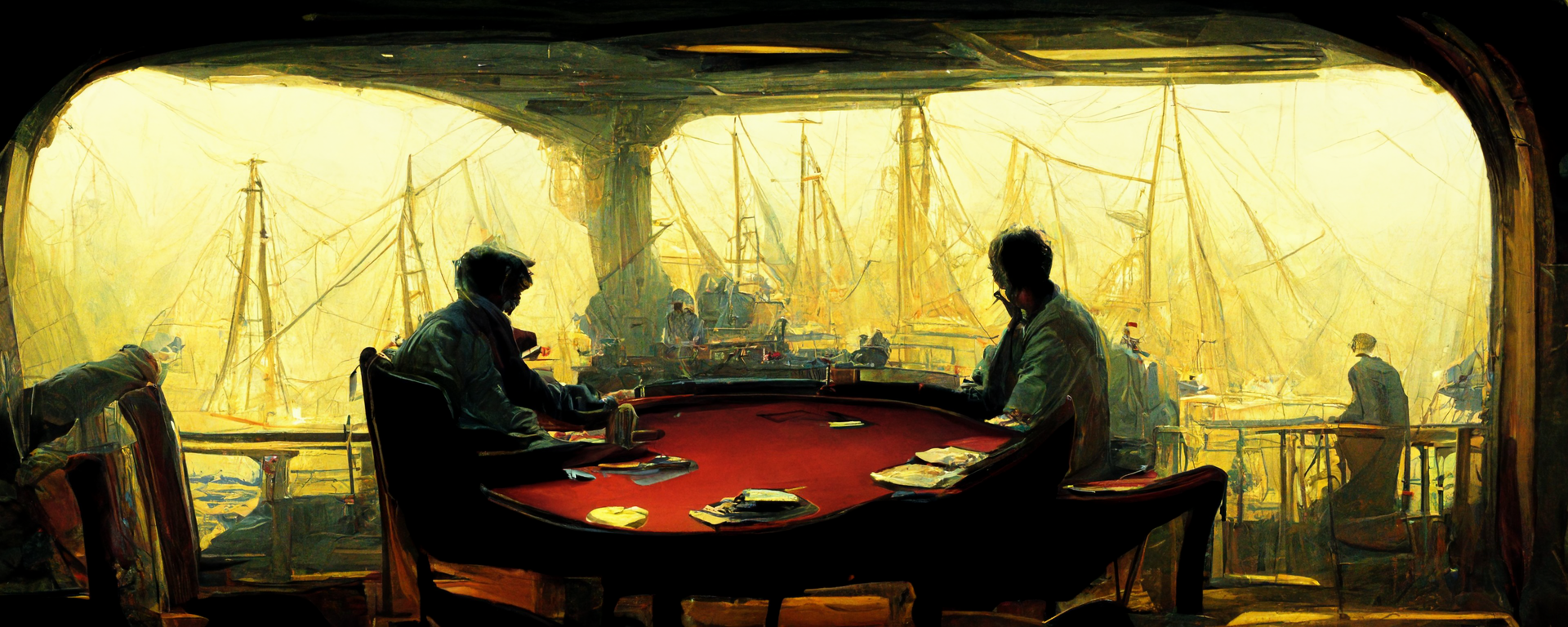
Dave King takes carpeted stairs into the basement of the Hawthorne Hotel in Salem, Massachusetts thinking of experimental fiction. A remnant of variegated clay chips hint that Donald Maass, John Vorhaus, Jo Eberhardt, Sean Walsh, and Mike Swift had been playing poker. An oversized Jack of clubs (big enough to be a placemat) and a couple of fresh pours of Guinness remain.
At the other end sits Lancelot Schaubert, the character, and he seems rather disturbed.
The disembodied voice of Lancelot Schaubert the author — not the character seated before Dave — says, “Come, Dave, have a seat. Do you like Guinness?”
Dave grabs a seat. “Absolutely.” He sips the beer. “One of Ireland’s gifts to the world.”
Lancelot the character (wearing too much tweed), leans forward in his wooden armchair and says, “Somewhere in the world, Sean Walsh praises your name from the highlands to the tune of some folk ballad. It seems my Idea (Author Lance) summoned us here to talk about experimental writing. How does experimental writing get in the way of itself?”
Dave sips, swallows, and says, “Story is all. Experimental writing works when it is the best, most effective way to tell a story. When the point becomes the writing itself, it becomes literary naval gazing. One caveat: some readers like elegant or shocking writing techniques. If I can quote myself, they read fiction for the same reason many readers read poetry. No one reads Elliot to find out what happened to J. Alfred Prufrock. Language-for-its-own-sake fiction, though, is not storytelling. Not better or worse, just different.”
In the corner sits a thrice- Frankensteined Macbook Pro covered in old Santa Fe skater stickers. Its screen faces Dave. The current app? A Discord server named THOSE CURRENTLY READING LANCELOT SCHAUBERT. It’s updating live from those reading this article as well as the entirety of everyone who has read, is reading, or will ever read Lance’s work, whether they hate it or love it.
The server dings from the readership diaspora — “Of course you can quote yourself, Dave: if Lance’s work has any power when he dies, it lies in his hope to have some small influence on academics, on nerds, and on average readers who steal time between nursing shifts (hi, Mom). Quoting yourself could serve that end: hoping to be understood and have understanding rearticulated back to you to know meaning was achieved. But what if the point of understanding is to say something about the nature of creative understanding? Is there a way to show how the making of all stories is a story, as a story?”
“Telling stories is part of what it means to be human,” Dave says. “In my purely non-academic, I’m-making-this-up-as-I-go opinion, part of the miracle of human communication is looking at someone else and putting ourselves in their head. We understand what they’re thinking. We can feel what they’re feeling. (Are you familiar with mirror neurons?) We have this talent, why not have fun with it?”
Lancelot, the author, writing — in part — from a Joe & the Juice on 43rd and 3rd in Manhattan, speaks forth his disembodied voice into the version of the Hawthorn hotel basement that exists in the loci of his mind and through the meeting of the minds, in Dave’s mind and yours. “I have things in my mind. These things mean what I mean. They also mean many things flowering beyond the seedbed of my intentions. But they cannot mean the opposite of what I mean. Whatever Harry Potter meant, it did not mean death is stronger than love. The readership must suss that out. Can we find value in showing that relationship, narratively?”
Lancelot the character sits, arms crossed. This incarnation brandishes considerably shorter hair, almost buzzed. “In some ways, I’m at the mercy of my own mind. But what happens to me does help folks sympathize with Author Lance and help them see what he sees, right? Isn’t that compassion?”
Lancelot the author says, “In our chat prior Dave mentioned Vonnegut showing the relationship of reader to author, of author as character to author qua author — poorly. Why?”
“It’s been decades since I’ve read Breakfast of Champions. I was not yet an editor. But if I remember, most of the book he intruded in the narrative like a cynical, world-weary nineteenth-century writer (a la “gentle readers”). At the end he stepped in and undermined the reality of all of the characters we care about, moving from nineteenth-century author to malevolent Deus ex Machina. Kilgore Trout ends yelling “Make me young again.” Wrist-slitting stuff. Manipulative. Vonnegut showed his readers very little respect.”
“We agree,” says the Lancelot fandom.
“By contrast,” Dave says. “You wrote yourself into Overmorrow as a genuine character. You as character didn’t throw your weight around. To do so would have broken the magic of the story. You existed on two planes — author and character representing the author — which let you enter the story without breaking its skein.”
The Discord server pings. “Three planes. What of academics who study a work, readers who leisurely enjoy a work, and creatives who try — by fan fiction or ephemera — to expand upon the work?”
Dave says, “Academics, readers, and fandoms all enter into the world the writer has created. Academics try to understand how it was created — the nuts and bolts, the meaning, past influences. Other readers try to encounter what the author encounters in their imagination. Fanfic writers are inspired to expand the story and make it their own. All three draw themselves into the world that the writer creates.”
Understanding, real encounter, and inspiration: the mind (or soul), body, and spirit of readership.
The Discord server does nothing other than ping incessantly with a random string of reader-specific emojis.
(Some in dissonant tones, but hey: it’s a readership — disagreement is part of it).
Dave says, “One of my favorites is the reaction to Larry Niven’s Ringword, published in the early seventies. Larry created a ring-shaped artificial planet circling a star, a livable surface of millions of worlds. He’d worked out all sorts of details — the speed to simulate gravity, a way to create day and night, erosion. His fans didn’t just write fiction about it. One calculated the tensile strength of the material it was made of. Another worked out orbital dynamics and found it unstable — if anything pushed it off a perfectly circular orbit, it would drift into its sun. In his next book, Niven used the findings to improve the Ringworld. It’s a strange feedback loop.”
Lancelot the fandom says, “Some even made the Halo videogame that Lancelot himself played in high school, which then becomes part of the compost heap in Lance’s own work. Fandoms predicate fandoms in this way: isn’t Dante just glorified Virgil fan fic?”
“You have a point.” Dave grinned. “This is true of nonfiction as well. I tell memoir writers to consider themselves a character. This is because, in writing a memoir, you need to use the same fictional techniques you would use to create a character in a novel.”
Lancelot the character tries — badly — to do léger de main with one of Don’s leftover poker chips. “Partly because the authorial incarnation isn’t the only part of the mind of the maker showing up in the story, is it?”
“The entire story comes from the mind of the author. And, yes, the author-character is more limited than the author-author.”
Lancelot the author interjects: “It’s not about the autobiography of the author, to be clear here (unless it’s an actual autobiography or memoir): yes, here we are in my memory in a sense. The Hawthorne hotel comes from one small room in the loci of my memory, a room in which I actually did meet Don and John and Jo and Mike. However, the point of this piece we’re co-creating isn’t to retell that meeting in my life, but rather repurpose that space — that locus amid my loci — for this meaning of the minds. Sort of renting out a room in my mind palace to any reader who needs a hostel.”
“Authors use pieces of the reality of their lives to create the fictional worlds in which their characters live. The fictional worlds don’t exactly copy the reality of the author’s life, but they generally rhyme.”
Lancelot the author says, “And that’s where uses of authorial incarnation radically diverge in two ways: malice and meaning. You have malicious actors who consider their fandom vainly, even as megalomaniacs or cult leaders. L. Ron Hubbard is one of these who set out to make a religion. Some parts of Vonnegut do this, others don’t — Slaughterhouse Five does it better than Breakfast, I think. But others seek to build a meaning like C.S. Lewis in his Dark Tower and Stephen King in his Dark Tower seem to be meditating on the nature of creativity per se rather than some masturbatory solipsism.”
“Lance the author seems to mean vanity, pride, solipsism, or otherwise self-focused writing. Looking at the vanity project of the author rather than whatever the author sees. Navel gazing, as you said,” the Discord server ads. “Seeing the author rather than using the author as a means by which to see. Therefore: is there a way to selflessly write about the authorial process? A way to even write about being an author, but to do so humbly for the sake of the entire world of creatives? That is to say, for humankind?”
Lancelot the character yawns and has pulled out the switchblade he smuggled across the border from Mexico in high school and started carving a near-perfect likeness of Richard Simmons into one of the wooden beams.
The author says, “Cool it: be vulnerable with your thoughts and let people enjoy them or not, there’s no need to feign boredom from insecurity.”
The character puts away the switchblade and sits up straight to listen to the Idea behind his Activity.
The author continues, “To meditate on the nature of creativity (especially novels) as fantasy-made-real is my hope in all of my work, though I may be failing more often than succeeding. That thesis is under attack from several rather vain philosophical schools, which puts me on the defensive, and therefore I can grow vain and fail. Dave has the benefit of having read three unpublished manuscripts of mine (Faceless, It Rides Upon Us, and Overmorrow — all three do this in various degrees of overtness, all three, of course, in Shunn manuscript format), but he also has read some of the published ones that others here might know: How did it work in Bell Hammers?”
Lancelot the character drops the Richard Simmons carving entirely. “I was Remmy’s grandson. I recorded the whole story. Remmy’s a polynym for Lancelot — the author’s — real grandpas. So I showed up as the narrator and in the story as the grandson born in 1987. Though the author changed some details. I think he made it better.”
Dave says, “From what I remember of Lewis, he did write himself into the story, but for him it was more a framing device. It gave the story a sense of verisimilitude for readers to know that one of the characters was a real person.”
“Two, technically, with Ransom,” Lancelot the character mumbles.
Dave ignores him. “There’s nothing malicious in meditating on the nature of creativity. What Vonnegut does is ruin the story to manipulate readers — bending their emotions to his will. I think you can write about yourself without the vain, self-focused naval gazing. Good storytelling is a gift from writers to readers. Even memoirs, which are focused on the author by definition, are often (not always) put out because they tell a good story that readers will enjoy reading. No, you didn’t get in the way of the narrative of Bell Hammers. You are still giving that story to your readers.”
“Are readers co-creating with their authors?” the Discord server asks. “I have nowhere read the color of the carpet at the Hawthorne hotel basement: I think it’s red shag.”
Dave sips. “Oh definitely. You can only give your readers so many details. They have to fill in the rest from their experiences. They form their own perceptions of who your characters are based on people they’ve known (and themselves).”
“Yanking the story away from them seems to be betraying the sacred author-reader trust,” the Discord server says.
Dave considers a second, fiddles with a spare King of spades. “I’ve been listening to “In Our Time,” a BBC interview show in which Melvyn Bragg interviews experts in various fields on a range of topics. One of their earlier shows was three people discussing masculinity in literature. A well-known feminist academic said she enjoyed Hemmingway because he never wrote about his characters’ internal lives, but invited his readers to create that internal life for themselves..”
A fifth voice enters the room, accompanied by the sound of footsteps with gravitas. It isn’t Dave or the Discord of Lance’s readership or Lance the character or the author. It’s one of Lance’s lycophoi — ancient monsters who assume the shape of humans. This one looks rather like Princess Diana in a white silk evening gown, but with a forked tongue. “And what of characters? Would it betray the wills of characters to ram rod them into inconsistent decisions? Even evil characters?”
“Oh, yes,” Dave says to the character. “Characters have to come across as people. They have to have their own consistent, self-contained view of the world. Their consistency is part of what creates the fictional world. When the characters start behaving out of character for the sake of the story, the fictional world collapses and the story is lost as well. Plot vs. character is one of the classic false dichotomies, like nature vs. nurture or Coke vs. Pepsi. Both are intertwined, and both need to be whole and entire for the story to stand.”
“How can I be plot?” the lycophis asks. “I am only me and only seek what I seek.”
“Stories are told about you,” Dave says. “And within those stories, you do, as you say, seek what you seek.”
“Polly want a kraken?” Lancelot the character asks the lycophis.
The tentacles of an eldritch horror start to pierce the portholes of the hotel basement, bringing in saltwater from the north Atlantic somehow.
The lycophis takes draconic form, leaves the room to feast on the giant squid.
“What about in Faceless?” Lancelot the character asks. “I showed up in that neither a bit passive (as in Overmorrow) nor in the background (as in Bell Hammers). Is there a place for the author in an active role within a narrative? Can it ever be immersive as opposed to distracting or malicious?”
“You don’t interfere in the story to any great degree. And you definitely don’t break the storyteller’s spell.”
“I suppose,” the author says, “there’s one question remaining: if the storyteller’s spell — the world building — remains unbroken, the will of the characters and their integrity remains unbroken, the trust remains with the reader, and the author-as-character does not exercise power to change any of these, is there any way for the author to get through to his most evil characters so that, as with all good stories, they change their minds for the True and the Good and the Beautiful in pursuit of a deceptively difficult — even evil — goal?”
“Evil people sometimes do see what they’re doing and move away from it. It is a transformation — μετανοια — that arises out of who they are. They are still themselves, but they’ve seen the error of their ways. It’s tricky to write, but done right, it’s immensely satisfying to read.”
Lancelot the character says, “It sounds like an out-of-body experience. As if a character would need to become a reader themselves. Of course to do that, they’d need to be able to meet the author.” He looks through the mirror right at you exactly where you are while reading this piece, he winks at you, and then passes Dave the second Guinness. “This one is for the way home. It’s five o’clock somewhere.”
Dave raises his glass and sips enough so that he won’t spill while climbing stairs. “This has been a lot of fun. I’m glad we did it.” Mr. King trudges up the soggy hotel carpet and back to where King-as-editor edits. He is a co-creator too, you know. Perhaps one of the best kind of readers: the first reader before the words become permanent. Without his mind, his presence in the work, not only would this not exist, but many of my works wouldn’t exist. And many more works that have yet to hit the shelves.
That makes the presence of editors just as important, but that’s a story for another time. Until we meet again for poker at some future UnConference, this is Lancelot the author signing off. I started this piece in the real world on that same busted Mac at the pretentious Joe and the Juice, but now I’m on my phone riding the D train home. Tara’s waiting for me, prepping veggies for green gazpacho. What veggies do you imagine her creation has used?


Comment early, comment often, keep it civil: