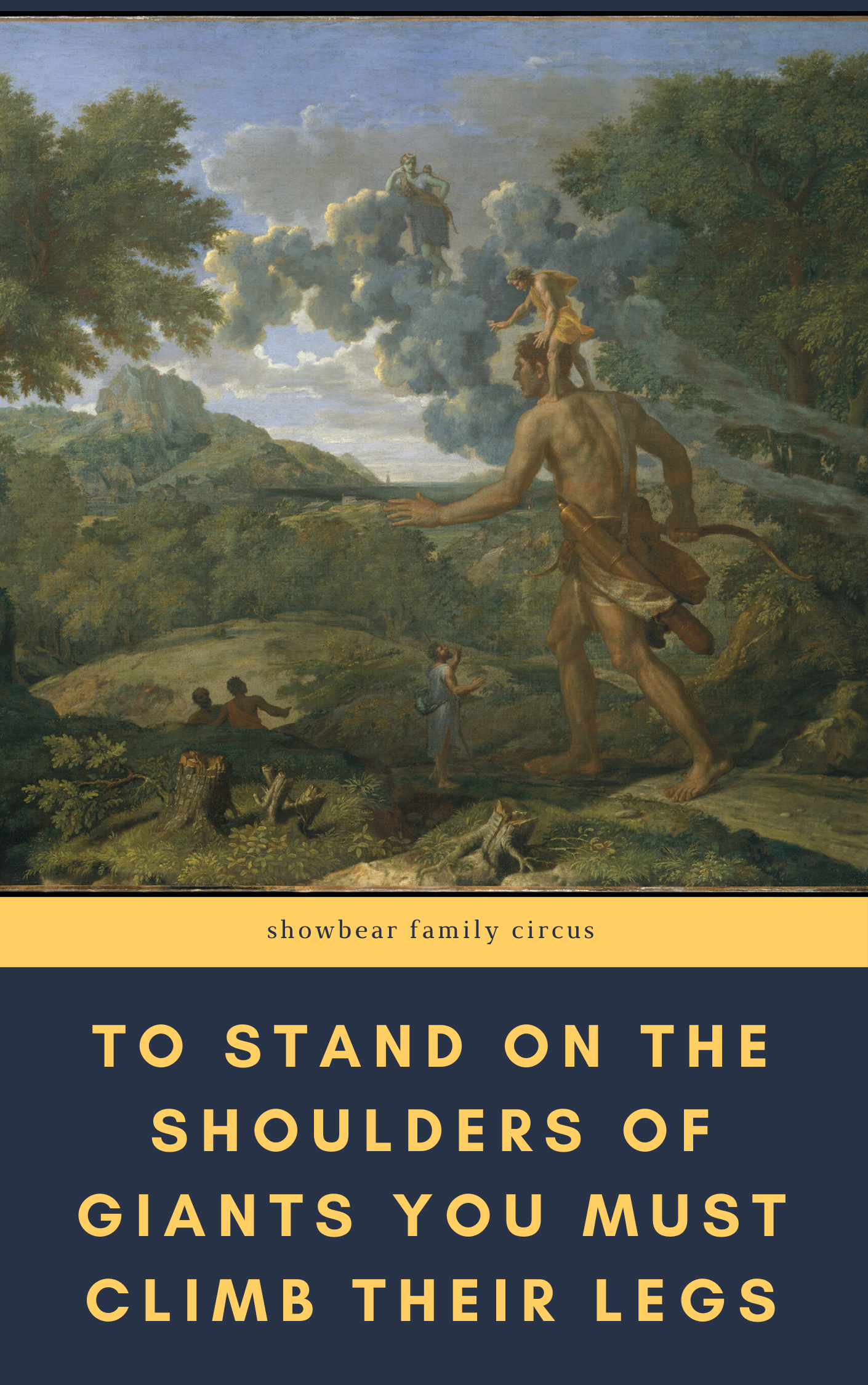
The great Coleridge quote (by way of Newton by way of Burton by way of Bernard of Chartes) that we see further because we stand on the shoulders of giants seems to be automatically assumed by the modern mind. We have “evolved” since the Greco Roman era. Even though clearly we are more barbaric. Even though the Greco Roman era is often cited in the same breath by the same minds as “progressive” with, for instance, their sexual ethics – however polycultured it tended to be on that front, depending on the Greco Roman era to which you refer. Even though “evolution” works neither than quickly nor that narrowly. Our society is “smarter” than theirs simply by being newer.
In reality, the modern mind has grown quite adept at technological innovation wedded to ethical, sociological, and metaphyiscal folly. And it’s, in part, due to education: we only stand on the shoulders of giants to see further and farther if we climb up there. What really happens is that empires – and the individuals who populate them – move in cycles between stoic and epicurean or civil and savage (in the sociological sense, not the racial sense: certainly Cahokia was every bit as civil as medieval guilds and vocation when compared to some of their neighbors). We do not see farther than Newton unless we read Newton as Einstein did. We do not see farther than Aristotle unless we read Aristotle as Aquinas did. We do not see farther than Chesterton and MacDonald unless we read Chesterton and MacDonald as Lewis did. And we do not see farther than The Bible unless we read The Bible as virtually every major thinker in the West has, nihilist or Darwin or otherwise.
The assumption is that we somehow passively receive what has been given in the wisdom of ages past, that we start out with a tuned up engine and a full gas tank and can take off into the wild. But this, clearly, is not the case. Donald Trump is not a man who has read Boethius. Elon Musk is not a man who has read Pope Leo’s encyclical on distributism or Heidegger’s article on technology or David Bently Hart’s Experience of God or N.T. Wright’s magnum opus on the history of the idea of resurrection. Hell, Jeff Bezos – much as he ruthlessly applied the principles of both Adam Smith by way of Henry Ford — clearly has not read even Adam Smith’s admission that capitalism only works with a virtuous man at the helm, speaking of course from a long tradition of virtue ethics. And, of course, good English boy that he was, Adam Smith published Wealth of Nations in a year he firmly believed nothing could possibly go wrong with corporations and their exports such as tea: 1776. Had he read the Biblical injunction against usury, he may well have saved him and England and the lot of us a good stroke of trouble within an “advanced” and “civilized” age in which, based on the common assumption, nothing could immoral could ever happen when one weds corporations to East India Tea.
The list goes on both in emergent properties cross sector and within one’s own area of expertise. I’m astonished at how few writers have read The Elements of Style, for better or worse. How few theologians have read the Summa. How few preachers have read the sermons of Chyrsostom, Martin Luther King Jr., Spurgeon, MacDonald, and Aristotle’s Rhetoric. How few politicians even know what Plato’s Republic is. How few law school students could tell you where to find a copy of Plutarch and further, why you would even care to look for it in the first place as fellow student of law.
Do we really see further simply by being born later?
We do not see further than our ancestors. We have become nearsighted, shallow, and trivial. And it’s precisely because we stand right next to giants all around us and refuse to climb up and see as they see, stand on their shoulders, and see further. It’s as if we army of dwarves have been given the greatest telescopes in military history and prefer to tinker away at siege engines while the enemy lazily surrounds us on every side.
When I ask my peers why this is the case — why we refuse to climb — the only reason they offer is that they fear getting made fun of for asking for a piggy back ride.
I believe the feel of the modern age is summed up in a friend of mine who has called himself a master storyteller. A friend who specializes in a completely different craft. Now I understand his aspirations. Understand his love of story. Understand completely how much better he is than virtually everyone in his town. But his major craft is not narrative whereas mine is. And I am just now beginning to think that I might have earned the title of “storyteller,” but I’m decades away from proper mastery of this one craft, let alone mastery in his. Why? I’ve only just begun to read the masters themselves. I’ve only begun to work through — only have recently had proper access to, having grown up poor and in obscurity — the master storytellers of history. And I don’t know, even when I die, if I will ever use that label of myself.
But here we are in modern American success culture and you’re unviable if you seem weak or ignorant or what have you. We seem to have forgotten that admitting weakness is the only way to figure out what needs strengthened. Admitting ignorance is the only way to find out what one need learn. And therefore shortness and near-sightedness becomes stature and vision only as one grows mindful of it.
Ignorance only grows into bliss when one choses to look — dead on — at that of which one remains ignorant and say with the children, “Wow.”
Let the little children come to Medici. Let the little children come to Bede.
You too, if you want to see. You must become like children.


Comment early, comment often, keep it civil: