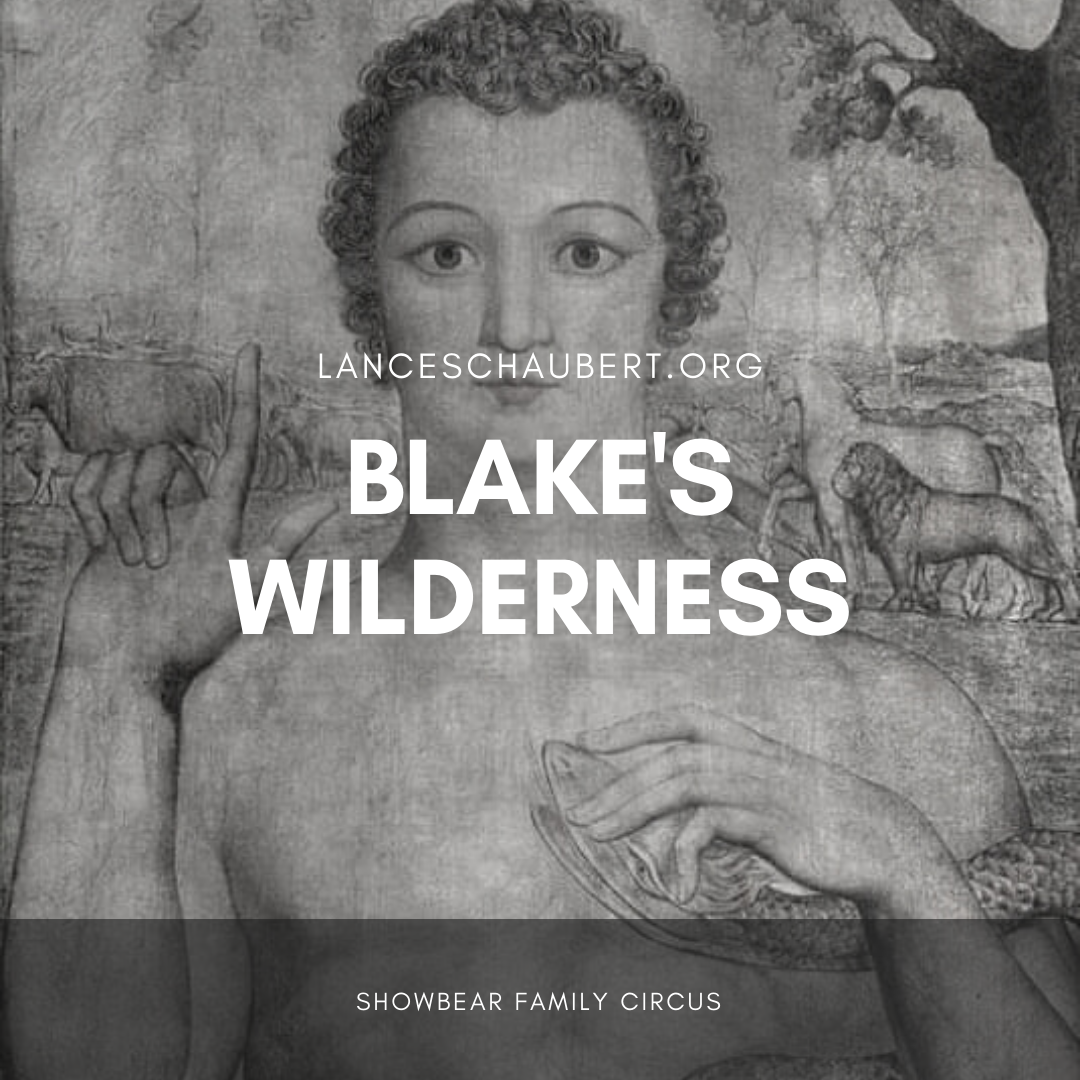
Call it rehumanization that reabsorbs what was separated out. In this reunification the horrific becomes beatific; tygers and lions “sing, they seize the instruments of harmony” (FZ 124.17).
Remetamorph, “further up and in,” as C.S. Lewis says in The Last Battle, reads like a salmon migration upstream, out of division into unity and not to separate again.
As the animals shed their skins of the human projection of limitation, “they enter upon a new life; as all forms of life rejoin Albion, they reject the Selfhood which has separated man from man and man from nature” ( Baine, 8).
Hence every threat perceived in the world from animals, including all nature, is simple fear caused by the human division mirrored out. The savagery of the tiger, greed, cruelty in any exterior form are human internal states, spiritual despondencies mirrored. So all creation is a mirror of positive and negative states, simple or profound. It is easy to see in the mirror that those negations include oil spills, extinction of species, poisoning waters and all industrial ills culminating in warfare. When the divided state is made whole it reabsorbs the fears that had been projected outwards.
Blake holds that all forms of life were originally part of man himself and were separated out of him, much as Plato says the woman was taken from the man. The destruction of the exterior world first began within. In Jerusalem Blake says “You have a tradition, that Man anciently contained in his mighty limbs all things in Heaven & Earth” (To the Jews).
We have to mix different contexts to document his view. In the Four Zoas he says:
“So Man looks out in tree herb & fish & bird & beast
Collecting up the scattered portions of his immortal body”
… where ever a grass grows
Or a leaf buds The Eternal Man is seen is heard is felt
And all his Sorrows till he reassumes his ancient bliss”(Four Zoas, 110b)
This reassumption is his restoration of all that has separated out, returned to himself.
“As man falls from vision, he objectifies into separate existence more and more aspects of himself. He stands in awe and horror, wondering where a beast like the tiger comes from, for he does not see in it a portion of his own fallen, divided self” (The Scattered Portions, Baine, 7).
In Mysterium Magnum Boehme says the primal human “image” was corrupted, which became “a Beast of all Beasts,” manifesting outwardly the inward negative properties. Medieval bestiaries reflect this, “Fox, Wolf, Bear, Lion, Dog, Bull, Cat” that go around the zodiac mirroring the divided human image projected onto animals. It is not the outward form of the animal that the man assumes, but the supposed inward ravening, or sloth, one of the seven deadly sins that “the Man must bear such a Beast in the Body” (Boehme). This theory of moral correspondence, inside as outside is “as the Essence is in the Body, so the Spirit figures and forms itself internally…unless that a Man be born anew.”
In all bestiaries as well the anti-shrines of the Spenser’s Faerie Queene, such as the Bower of Bliss, external nature reflects the inward man/woman. Reabsorption is the opposite of being absorbed into nature at death, which gains natural significance in ashes to ashes, dust to dust, or as Wordsworth’s leech gather might say symbolically, “a huge Stone is sometimes seen to lie / Couched on the bald top of an eminence.”
There is self similarity between what we call collective intelligence, or globalization, and the “universal man.” From a certain point of view globalization is a reunification and a kind of fulfillment of the Platonic prophecy. M. H. Abrams says “Blakes’ prophetic books narrate various stages of the division and reintegration of the Universal Man “The ancient mythical being, the primal Man or Ur-Adam, who falls into fragmentation…a progressive dissociation of the collective human psyche into alien and conflicting parts” (Natural supernaturalism: Tradition and Revolution in Romantic Literature, 257-258), that is into four parts, and then into four (feminine) emanations, then into spectres. These fractal images divide and subdivide to some end point whence they rebound in the person of Jesus, in “resurrection to unity” again. Thus “all things are comprehended in their Eternal Forms in the Divine Body of the Saviour” (Ninth Night of the FZ) to be reabsorbed.
So Man looks out in tree & herb & fish & bird; beast
Collecting up the scatterd portions of his immortal body.
All negatives proceeding from the one human are reabsorbed back! Much is written of these two polar beings. Two “contraries” fight to produce consciousness, progression, an upward sloping line, and while there is more in Blake of sexual subdivision and social politics, his future of united man/woman makes a system of unity. Though Abrams rhapsodizes the Universal Proposition of ancient unity, what couldn’t be cited either from Schelling, Hegel or occultism, Brahman’s lives, wheels within wheels, is that “all natural objects not only become human themselves, but reunite, without loss of individuation, into the Human Form Divine” (264) from which they had fallen. The natural becomes human! Pathetic fallacy reversed. Who says poets and critics aren’t religious! This vision gains credence from its position at the end of Jerusalem where Albion, the unity man, and Jerusalem, his emanation, get married. These takes are prophetic extensions of the New Testament as understood by visionaries, but not a teaching found else.
All Human Forms identified, even Tree, Metal, Earth, and Stone;
all Human Forms identified, living, going forth and returning wearied
Into the Planetary lives of Years, Months, Days and Hours; reposing,
And then awaking into his Bosom in the Life of Immortality.
And I heard the Name of their Emanations: they are named Jerusalem.
Viewed as a cosmology, this pan-creationism is so infectious that it encompasses cycle and recycle, projection and return. We should have to take it up in fiction, but it helps to remember that it was already fiction that was naturalized into reality from mysticism, astrology and kabbalah.
So, in a more recent sense, if, Scott Momaday returns the bear to himself, entered in childhood by way of myth. “I suspect it is that part of man which is subhuman. Primitive. Most people cannot recover nature. At one time, we lived in nature. But somewhere along the way we were severed from nature. And we cannot any longer comprehend the creatures of nature. We don’t know about them as we once did. But this boy is an exception. He turns into a bear; that means that he reconstructs that link with nature. You could talk about the bear as being the underside of his existence” (91). Blake says wilderness is a particular of man. Momaday says Bear is a particular of wilderness. Shown here is the backside of Bear.
He tells of Ur-bear, All Bear, One Bear, the Bear of Bears. In the principle of vitality, “I am a bear,” I hear, “I am a man,” but shorn of perjury. “You accelerate your activity…feel greater kinship with the animal world and the wilderness” (Conversation, 16)…”a great potential for disintegration” (17). In the Bear’s Name says that “I am less interested in defining the being of Bear than in trying to understand something about the spirit of wilderness of which Bear is a very particular expression…if you look at him very closely and long enough, you will see the mountains on the other side. Bear is a template of the wilderness” (9). Seeing mountain through bear is the essence of this. “Even Urset, who is the original Bear…is symbolic and transparent, more transparent than real” (9).
Seeing Mountain Through Bear
What is on the other side of the see- through bear? “He is an imitation of himself, a mask. If you look at him very closely and long enough, you will see the mountains on the other side” (9).When he says “I have been possessed of Bear’s spirit” (9), it is not animism or idol, but the One thing, the One being, should you learn that name in its best picture: “Let me say at the outset that this is not a book about Bear (he would be spoken of in the singular and masculine, capitalized and without an article), I am less interested in defining the being of Bear than in trying to understand something about the spirit of wilderness” (9). If possible he makes you love Bear more.
Here above we see the underside of bear. Want to see its face? Be glad as Moses to see the Back (Exodus 33.23). He becomes the bear, and God comes to man, as Blake has it, in Christ, which incarnations of form all practice unities. Blake thinks that thinking makes it so. No external agent implied. It is a fantasy, but it is something like what Donne meant when he called out to the scattered bodies to return to their scattered, numberless infinities.
HOLY SONNET VII
At the round earth’s imagined corners blow
Your trumpets, angels, and arise, arise
From death, you numberless infinities
Of souls, and to your scattered bodies go ;
All whom the flood did, and fire shall o’erthrow,
All whom war, dea[r]th, age, agues, tyrannies,
Despair, law, chance hath slain, and you, whose eyes
Shall behold God, and never taste death’s woe.
But let them sleep, Lord, and me mourn a space ;
For, if above all these my sins abound,
‘Tis late to ask abundance of Thy grace,
When we are there. Here on this lowly ground,
Teach me how to repent, for that’s as good
As if Thou hadst seal’d my pardon with Thy blood.
2. Blake as the hero of the chimney sweep, wrote of mass extinction from the beginning industrial and now agricultural revolution (atrozine). With many prophetic celebrations of the natural we wake up to find ourselves peering deeply into psyche to determine cause. If Blake is the first to celebrate the human toll of industrialization in his chimney sweep, he is also the prophet to explain the fear of nature, animals, the tree, and man’s fear of woman, all which sums concurrent in the fear of himself.
Blake refuses to benefit from evil. He justifies his thought by passion, art and integrity, as much as any martyr against the world of profit. Putting Boehme or Swedenborg aside, the Bible figures largely in Blake and the versions of the English mind. Blake’s vision of reunficiation, the Platonic prophecies of unity, the new heaven and new earth of Isaiah and the Testaments reach a kind of fulfillment where to name the animals, understand, dream them, meditate like St. Francis, not like a biologist thinning horse herds to fend for cattle is a sense of this unity is paradise.
Preconditions of paradise exist, the main one is health; to think free of hindrance, fatigue, prejudice, greed. Do not worry however that paradise art will lose Goya, the world is all Goya, the man cudgels himself. Goya exists, paradise must be found.
Note: A search for platonic prophecy of this unity is bare, but see Platonic Prophecy here.
But see too, Ariel Kofsky. Eusebius of Caesarea against paganism. esp Ch. 5. Prophecy in the Service of Polemics.
Notes: Wikipedia
The concept of “restore” or “return” in the Hebrew Bible is the common Hebrew verb שׁוּב (shuwb/shuv),[8] as used in Malachi 4:6, the only use of the verb form of apocatastasis in the Septuagint. This is used in the “restoring” of the fortunes of Job, and is also used in the sense of rescue or return of captives, and in the restoration of Jerusalem.
This is similar to the concept of tikkun olam in Hasidic Judaism.[9]
Tikkun olam (Hebrew: תיקון עולם or תקון עולם[1]) is a Hebrew phrase that means “repairing the world” (or “healing the world”) which suggests humanity’s shared responsibility to heal, repair and transform the world. In Judaism, the concept of tikkun olam originated in the early rabbinic period. The concept was given new meanings in the kabbalah of the medieval period and has come to possess further connotations in modern Judaism.
No matter what we say of the view expressed here, at least it holds the actor to account, the man, the human self. Are we so desperate to understand extinction that we resort to Platonic nonsense?


Comment early, comment often, keep it civil: