Each time I teach a literature course, I ask my students some version of this question, “What is literature?” Often it’s a question they haven’t considered, and we usually end up discussing our class reading list versus some of the more popular novels they know of. This leads us to talk about why we are still reading some works, and why some of those New York Times bestsellers won’t be remembered within a few years. Some of the works from our class reading list are three hundred years old and were written in a foreign land in a language that none of us speak. It is a remarkable thing to consider a fictional work or a poem or a play being read not just one or two generations later, but dozens of generations later in a part of the world the author couldn’t have imagined.
A simple, boiled-down reason for this that is also a partial answer to my question “what is literature?” is that in these works is an appeal to our common humanity. Though the circumstances and setting may be distant and antiquated, the issues and the problems facing the characters aren’t. They are just as fresh and relevant as any news headline appearing in today’s newspapers. Yet they transcend today’s headlines, moving beyond them. It is this strange combination of being firmly grounded in reality and also transcending any one time and place that makes a work literature.
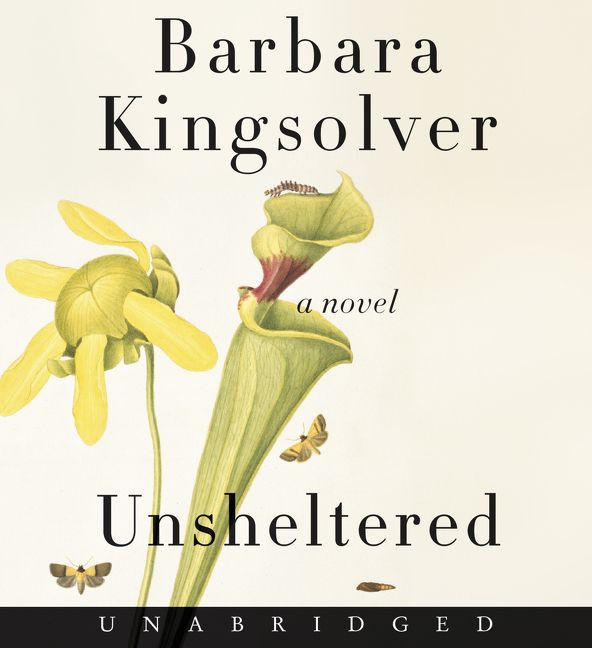
This tension flitted through my mind several times while reading Barbara Kingsolver’s novel Unsheltered. In fact, Kingsolver herself points out in the afterword (that is included in the Barnes & Noble edition of the book) that “the alchemy of literature is in its translation of global-scale themes–like, let’s say, the disposition of social collapse–into the intimate language of human experience.” She knows how literature works, so our discussion here is not irrelevant.
This novel is grounded in a very contemporary reality. It follows the daily life of Willa Knox and her family, who live in present-day New Jersey. Willa, her husband, her father-in-law, and her grown children occupy a large historical home that is falling down around them, and the condition of the house mimics the chaos in their personal lives. Each member of the family is facing a physical, emotional, or financial crisis (or a combination of all three), and their individual crises overlap and intersect that create scene after scene of turmoil. Interspersed with the scenes of Willa’s family are scenes of another family who inhabited that same home in the late 1800s. Thatcher Greenwood is a young science teacher trying to establish himself in his new town, but he unfortunately makes himself an enemy by teaching the relatively new principles of evolution. The thread that is supposedly connecting the two narratives is the tempestuous nature of the lives and times of the characters–that leave the characters feeling unsheltered.
I want to focus on the elements of Willa’s story specifically that made me wonder if it will be one that lasts. Willa’s story takes place during the last presidential election, and while Kingsolver never names Trump, the numerous descriptions can only be about him. We also learn that Willa’s father-in-law listens to conservative radio show hosts who were “jocular, obscenely confident commentators who disparaged any kind of progressive thinking.” There are other details about Obamacare, the immigration crisis, child custody agreements, sustainability, and hedge funds. The family’s life seems to revolve around each of the events that has captured our nation’s recent attention.
This is not a bad thing. Sometimes stories allow us to talk about the broken things in a culture in a more powerful way than a straightforward op-ed piece can. However, the storyteller must always be aware of the use of details and their ability to help or hinder the storytelling. It is the specificity of details in Unsheltered that perhaps indicates that this novel will not be able to transcend its specific time and place to appeal to the larger experience of humanity.
A while back, I wrote another piece about a novel dealing with a very specific time in history. Suite Française by Irène Némirovsky is set at the beginning of Nazi Germany’s occupation of France during World War II. We don’t need to understand all the details of the occupation to understand the behaviors and attitudes of the French and German characters in the novel. This novel has at its core some basic human desires: love, freedom, security. And we, as readers, understand how a war could threaten those.
Or take an even older work, like Charles Dickens’ A Tale of Two Cities. This work jumps between France and England during the French Revolution. The tyranny of the guillotine is a very specific detail of this particular time. And yet, the circumstances the characters find themselves in during this hellish time are filled with the same kinds of phenomena a modern audience can understand: the need for dignity, the value of honesty, the price of courage.
My concern for Unsheltered is a forest-for-the-trees kind of concern. I wonder if the daily details of Willa Knox’s life eat up too much of the story space and obscure Kingsolver’s ultimate purpose. Instead of functioning as a vehicle for a journey that will take us to larger truths, I felt that the details become the destination. I am trying to imagine a reader two or three generations from now being able to keep up with the story who was not familiar with the happenings of the second decade of the 21st century. If that reader gets lost in those details, then he will surely miss out on the specific slice of human experience that this story attempts to communicate.
In your own reading, especially of more modern works, I would encourage you to ask yourself these kinds of questions about transcendence and universal appeal while you read. I know that none of us would make very good prophets, but this practice may just make us better readers.


Comment early, comment often, keep it civil: