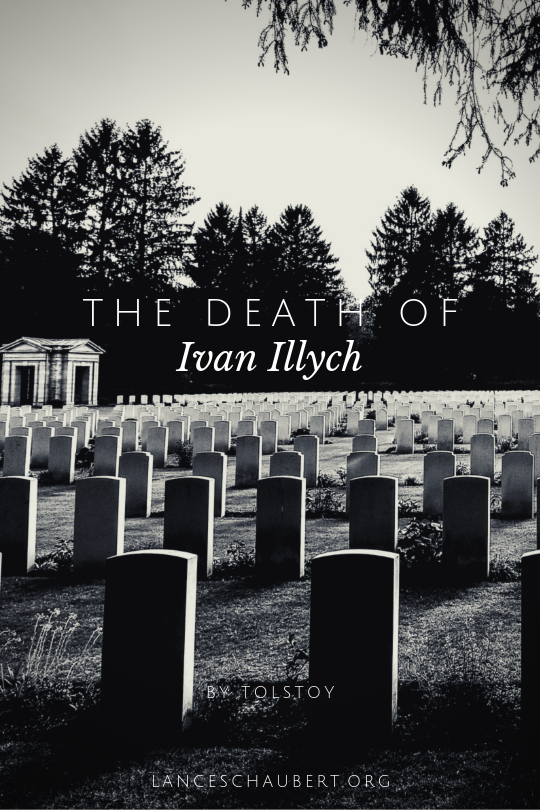
“Ivan’s life had been most simple and most ordinary and therefore most terrible.”
I underlined that sentence when I first read the novella The Death of Ivan Ilych by Leo Tolstoy about a year and a half ago. I was prepping for a new World Literature class that I was soon to teach, and I was trying to narrow down the reading list from the monstrous anthology I had chosen. This line is part of the reason the novella made the cut. (Another reason: it can be read easily in a couple of evenings. I love the Russian greats like Tolstoy and Dostoevsky, but their masterpieces aren’t for the faint of heart, and I didn’t want to scare my students the very first day of class.) That line had power, and it smarted inside when I read it. It still smarts now as I am reading through the novella again for another semester.
I knew that my college students could connect with this question that resonates throughout the work: what if the way I have been living my life isn’t the best way to live? Ivan is admittedly ancient by college student standards; he is forty-five when he dies. And he experiences a long, drawn-out illness that leads to his death. (Don’t worry, no plot spoilers here. The title gives it all away.) Those two factors may seem to make him an unlikely character for a college student to connect with. But college students are in a beautifully precarious position to contemplate questions like this. They are separating themselves from the family they grew up in, stretching and flexing those wings as they perch at the edge of the nest. Their newfound perspective gives them insight into the way their loved ones have lived that they didn’t see when they were firmly entrenched in family routines at home. They are also experiencing the lifestyles of other new, young adult friends, older mentors, co-workers, bosses, and anyone else who happens to cross their paths. They are incredibly inquisitive, but not just for the sake of curiosity alone. They are looking around them, absorbing all they see, because they want to know how to live their own lives.
Featured Download: click here to get the infographic on how to read reflectively.
Enter Ivan. When the class started discussing the novella, my students were horrified, irritated, mournful, and shocked as they progressed through the work. None of them remained aloof and unconnected. They saw with great clarity that Ivan had been the cause of his own demise, simply because he wanted to live a “simple” and “ordinary” life. Tolstoy uses words like “simply,” “pleasantly,” “easy,” and “agreeable” to flesh out for us this lifestyle. Ivan’s desire to make a name for himself in his career, his materialistic passions that drove him to furnish his house with all the accoutrements that were in vogue, his superficial friendships and relationships that were based on quid pro quo kinds of behavior—all these spoke to my students. They saw the hollowness and futility of this kind of “ordinary” life.
I feel it as well, the cold metal of the trap Ivan was in. I keep on checking my surroundings, to make sure I’m still on the outside of the trap. But it is so easily disguised and camouflaged. The “simple” and “ordinary” life takes on so many forms: the new phone I’ve come to believe I can’t live without, the kitchen update that looks so much better than my current kitchen, the vacation that promises refreshment that I can’t seem to find in my daily life. Just about any moment that seems normal could be the shiny bars of the “terrible” life Tolstoy’s character experiences.
Ivan doesn’t realize the existence of the trap until his illness settles in for the final stretch. In fact, Ivan fights the realization that dances at the edge of his conscience. He can’t and won’t accept that the way he has lived was the wrong way. I find myself haunted by Ivan’s blindness. I keep on questioning if the choices I’ve made about how to conduct my daily life are the right choices. I wonder how deep the stain of consumerism and materialism goes inside me. I fear that I sometimes get caught up in the trivial and miss out on the meaningful.
Tolstoy shows us how one man faces his own mortality and grapples with his life’s path, both the path he’s already walked and the brief path he has yet to travel. In the end, it is Ivan’s death that is significant—significant enough to make it the title of the work. I read this slim book wishing that “life” had figured more prominently into Ivan’s life and hoping that I can keep a deep, real, and meaningful life squarely in my own field of vision.
Featured Download: click here to get the infographic on how to read reflectively.


Comment early, comment often, keep it civil: