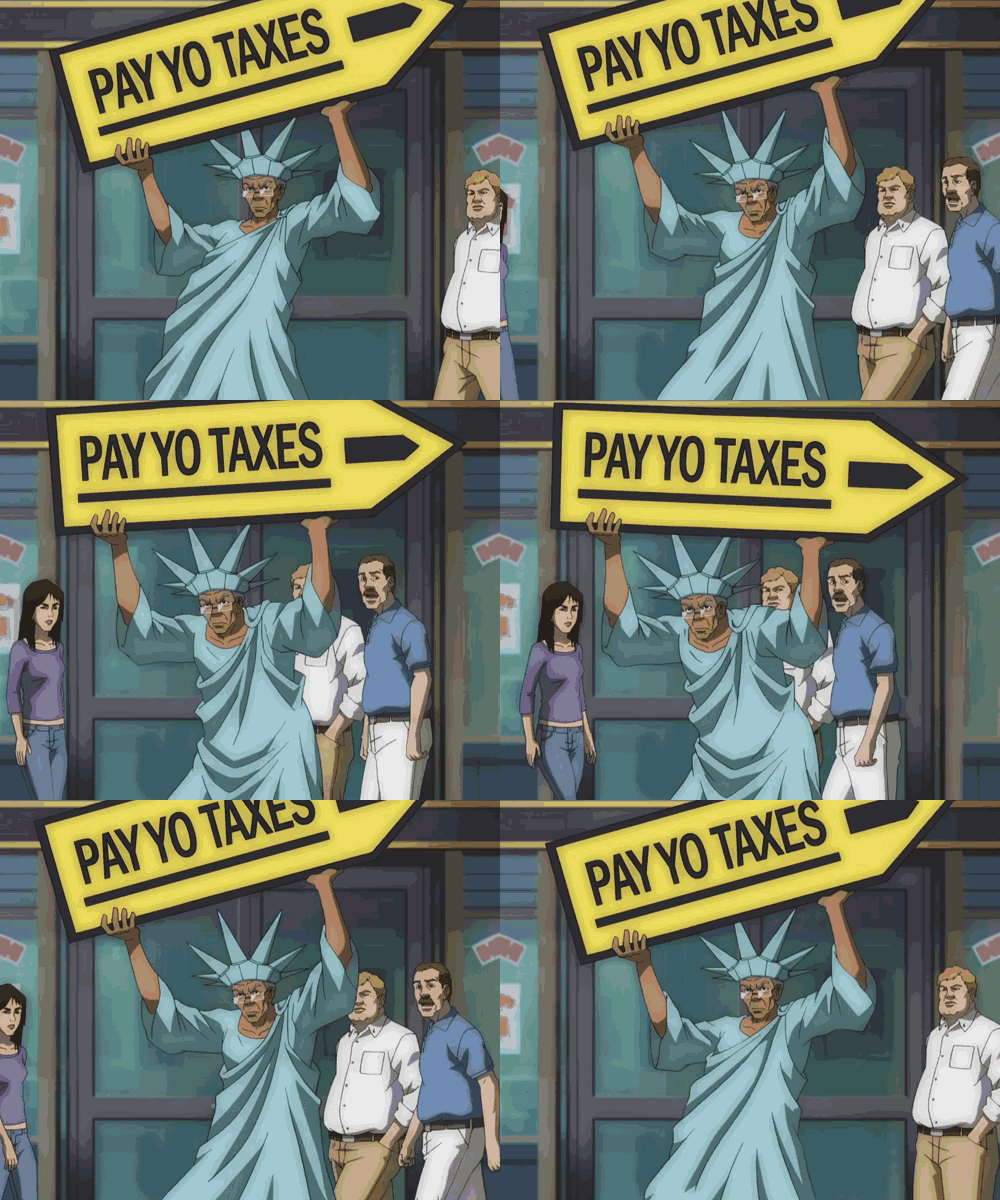
I haven’t been writing my poems, my sonnets, my tax psalms. You know the old saying: might as well blog about it.
There are lots of quotes, attributed to many and various writers, about how hard it is not to write when you know you need to. I’ve spent so much time notwriting that to call it difficult is totally false. It’s fairly easy for me to notwrite, and it feels as though I have to summon the willpower from some subterranean reserve when I dowrite.
Not that the dowrite is so odious. I experience poetry-writing in particular as a bodily function. Not especially pleasurable or painful, but natural and necessary. Yet whatever spark might once have driven me to the page is dim if not, in this season, extinguished.
As of this writing, it’s tax season, and like many Americans I’m strung out on anxiety (also I wish April 16 were a government holiday so we could all collectively scream with relief for 24 hours straight). Fear is eating my heart. With my heart, its song.
It wasn’t until the day I filed that I wondered where one might find poetry in taxes, if one looked hard enough. It was a wondrous thought, but then I skimmed the 1040 and Schedule C now imprinted in my brain and found only dry and punishing calculations.
Which is, of course, a perception problem. Taxes are not inherently dry, punishing, or fearsome. —You know who I’d bet on writing a good poem about taxes? Kimiko Hahn. But I digress.
What I’m getting at, indirectly, is this: singing is the antidote to fear. A season of stress, then, provides all the more reason to write poetry, sing my wordsong.
My excuses don’t stand up to that truth. And yet, with dry and punishing calculations of my own, I keep making them.
Steven Pressfield’s The War of Art explores this resistance at length. I recommend that book to anyone well-acquainted with notwriting, notpainting, notdancing, notacting, etc. Pressfield shows you the many faces of artistic resistance (avoidance, distraction, busyness, fundamentalism, substances, sex) and why they’re all just elaborate fear jungle gyms we’d rather jump through than sit down at our desk and face the work we know we have to do. See taxes, above.
It might be worth examining not only why notwrite, but also on what we gain in the dowrite. I’m reminded of something Mary Ruefle said to a workshop. As best I can remember, it was this:
“The publishing industry has been going on long before you were born, and it will go on long after you die. But your writing was born when you were born, and it dies with you.”
My poems may not be perfect, may not always be beautiful, musical, or very meaningful—but they are mine. Maybe that tax psalm is something only I can create. Just as your poems (stories, essays, whatever) are yours and yours alone.
What do we gain, then? A dropping down into the true self. A soul-settling. If I feel the tug to write that tax psalm, and if I answer it, I just might be rewarded with what I referenced in my first post: integration of cold-blooded will and reckless imagination. Combined, these powers can build cities, explore oceans, teach me new languages, endear me to strangers—all without rising from my desk.
Write something only you can write, and so will I, whether anyone’s around to hear it or not. Let’s see how far we can go.
Featured Download: For a quick tutorial on how to write your own poetry, click here.


Comment early, comment often, keep it civil: