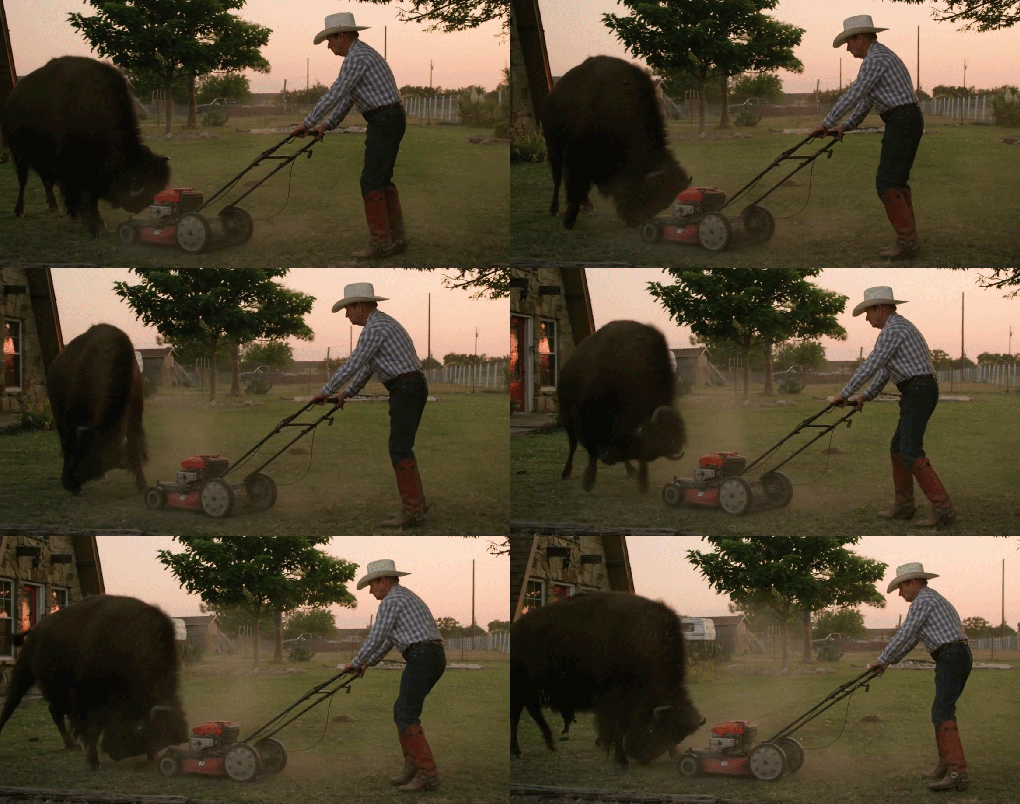
I submit, as evidence, a selection of titles from his New and Collected Poems, 1970-1985: “The Assassin.” “In the end is the word to destroy the world.” “When news came of his death I was disappointed.” “At the End of the World.” “Cautiously, to die cautiously.” “I am dreaming of the funeral of the world…” “The Suicide.” “The Dead Sea.” “Death of a Lawn Mower.” “Is There a Value to Life?”
I read some of these poems under the cherry blossoms in my backyard and felt a chill. Reading something so relentlessly bleak, the desire is either to laugh (see above) or confront the reality Ignatow wraps his poems around. Or maybe I chose yet another alternative: to attempt to understand his point of view, set my own aside for awhile.
Although I haven’t read the entire collection and don’t intend to (see below), the poems I read are plain-spoken and severe. The language unembellished, the syntax straightforward. Content-wise, the associative leaps follow dreamlogic, and stark existential questions surface without warning.
The poems read like stripped-down parables from a very morbid teacher. The images and language are distilled, the tone full of dread.
I can imagine a reader feeling confused by Ignatow’s pessimistic endings and surreal scenarios, but I find there’s remarkably little subtext in these poems. Ignatow is not asking you to decode anything. He says what he means, and if you’re looking for some theme or explanation, chances are it’s in the poem already.
Reading the first few poems, I chafed at this frankness, the lack of mystery. Then I stopped myself. Is there anything wrong with saying what you mean? Of course not, but this is not the poetics I was taught to admire or emulate. I was taught to embed meaning in images. Sometimes these images are screens for some unsexy confession, sure, but often it’s more that I don’t know exactly what I want to say; I just know the image strikes me, and I want to explore it.
The Poetry Foundation’s profile of Ignatow quotes the poet’s interview with The Paris Review. Ignatow dismissed poetry in which “language takes precedence over content.” In the same interview he depicted other contemporary poetry as escapist, in contrast to his fixation upon the mundane and macabre.

Indeed, death is one of the worthiest subjects one can write about. And I, an unabashed escapist, could stand to think (dare I say write) more about said subject. But just because something is beautiful—in its language or content or both—doesn’t make it less true. Beauty and love get a seat at the table along with death, in literature as in life.
Not that Ignatow was blind to this. He himself, I learned, wrote about love later in his career. After I read several early poems and got bummed out, I flipped to the very back of the collection.
I study the folds of fat round your waist lovingly, as you bend over naked to slip on your panties… I see rolling hills endlessly stretching before me, and my heart is lifted that I will walk these hills for my lifetime. (“I Will Walk,” p.310)
Kinda sweet, huh? There’s also one where someone farts while the couple lies in bed. Interestingly, death doesn’t come up much in this series. Not even a “silent but deadly” reference. And it was right there.
In “Proem” (p.320), I found what might be a key to everything I’d read. It begins:
Is a tree guilty?
Can water be condemned?
The speaker goes on to consider a family living in a house, prizing love at the center of their lives and withstanding the forces of disaster and death through unity. But the tree, like the family, trying to live, breaks the foundation of the house with its reaching roots. Water, finding its way, floods the basement. So then, who is the guilty one?
The speaker sees the family fall apart after their physical house is compromised. He asks again whether the water or the tree are at fault. He continues:
Is the world a place in which to accuse one another of the guilt of living? Is there something to being born that is wrong? Is it wrong then to want to live? Is it wrong to live?
Here, although I think he could’ve trimmed it down, I’m grateful he’s making his conundrum plain. In so many of his poems, the poet anxiously foists blame on himself or others, but the question never feels settled. Here, again, it hangs bald in the air. I wonder if the implied answer is something to the tune of: “Maybe it’s wrong to live, or maybe it’s right, but either way I’m going to continue living.”
What’s also wonderful is the compassion Ignatow extends to the tree and the water, how they are like us in our unruly families, just trying to get on through life. It’s absurd, he seems to say, that the simple intersecting of lives can cause such turmoil.
I took from this reading experience a formal framework: to write a dreamsong in prose-poem form, and include probing questions as I go. The confounding prospect of a tax poem, which I discussed last post, felt less intimidating when I considered giving it the Ignatow treatment. I leaned into the plain-spokenness, which doesn’t come naturally to me. This line, for example, felt weird to type: The shiver in my neck a haunting—not of a soul’s fraction but fear of the Internal Revenue Service. Soul’s fraction, though. That’s something.
(Would Ignatow consider that putting language over content? I’m not sure how to defend against that accusation except by saying I really did want a more interesting term for “ghost” so the reader wouldn’t just sail by that familiar word. And fraction is a math term, i.e. somewhat tax-related. Although maybe everything I just said supports the language-over-content thing… Oh well, I’m not going to sacrifice my love of wordplay over this.)
The simple fact of this Ignatow book is that it’s not exactly for me. Sure, his style reminds me of writers I love—Mary Ruefle, Lydia Davis—but it made me wish I’d stumbled upon a single Ignatow poem in another context. This is not the kind of writer I want to read over the course of several afternoons with my tea. So I’ll take it back to the library and let someone else have their turn.
Featured Download: For a quick tutorial on how to write your own poetry, click here.
Image credit: Giphy


Comment early, comment often, keep it civil: