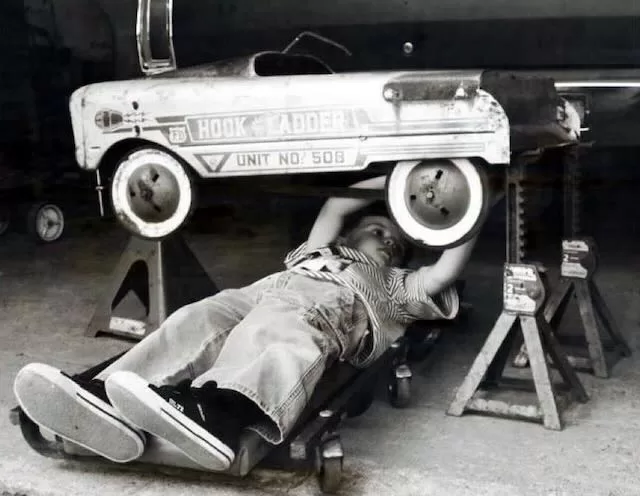

In that house on Circle Drive, the garage pulled into the basement where dad did truck maintenance. It’s funny because I remember that. And I remember the upstairs, the porch, the attic, my room. My memory is almost entirely blank on my parents room unless it was the one that had the green textured paint. I have a hunch that was the bedroom in Cottonwood, one of the two. So I can’t actually remember the access point to the garage. Maybe they simply carried me every time. I do remember the daycare at Rend Lake college probably most vividly. The other children there, the pickup sticks with the marbles, the great colored tiles or floor squares while mom learned nursing.
But the garage I can’t quite remember. I do remember my father’s truck. And therefore glimpses of truck maintenance. He almost exclusively bought Chevrolet when he bought trucks, otherwise he’d traded pink slips all over the place for different vehicles. At once point this included a lime green diesel stick shift Volkswagen bug with offroad tires. That one looked like what you expect might come out if you ever see a male chihuahua mating a Great Dane. A sight in itself to be sure — the closest I’ve come to witnessing that is the Harry Benson photo of the Dalmatian doing similar.
The truck was white and rusting out in my memory, though I can’t believe it would be so then. It had red runners. It also had a great white ladder rack on top. It occurs to me that this may have also been my Grandpa Remmy’s truck (his name was Jerry, but so many of you have read Bell Hammers by now, there’s almost no point in avoiding the convergence of Jerry and Deno into Remmy). I remember how little fear he had.
And this is one of the things that also seems a qualitative good of even the most barely competent fathers.
So many parents in New York City seem afraid and so do so many in the suburbs and in the country. In the City, depending on the parents, you often find absolute germaphobes. Folks that won’t let their children touch the handrails on the subway and so their children fall. Or they won’t let them touch the subway poles and so their children never learn to stand. Who won’t let them sit on benches and so they never socialize or won’t let them touch a crosswalk sign and so they seldom learn to cross the street. In New York, an inability to cross the street is as good as crippling a child.
But a similar thing happens. In the suburbs, it’s a fear of trying public transportation or meeting neighbors. A fear of exploring the city unassisted. And a fear of exploring the country unassisted. The word they used when the medieval sheep were no longer allowed to roam was enclosure. It cordoned off the commons. I believe that’s the perfect word to describe suburban children: enclosure. They are domesticated wolves, domesticated boars, domesticated bobcats turned to dogs and pigs and the sorts of cats who spray you and leave mind-altering toxins in their feces.
In the country, it’s a fear of other people. A child will learn how to use a firearm properly at an early age, but also immorally. They’ll learn gun safety for themselves and a hunting partner, but will learn also that BAD MEN ARE OUT THERE and will be more likely to use a weapon on a fellow human child, their parents, or just any other human soul who looks at them wrong. It was, I’ll remind you, a mentally disturbed man from Ohio who shot up my neighborhood’s subway — he wasn’t from New York. He was a tourist from the country. There’s a similar thing where cattle and field and welding and other incessant dangers like anhydrous ammonia (and the sorts of things country kids build out of such chemicals) all seem relatively safe. It’s other people that scare them and this becomes in its own right a breeding ground for terrorism, statistically.
So in the city, people fear germs — which is to say dirt, woods, and the mental contagion of those ignorant flocks of folks in suburbia who love the vacation factories of Disneyland and cruises; physical and mental dirt. In the suburbs, they fear anything insecure and so the surveillance state — both in terms of the proliferation of geocached metadata family photos, Facebook, home “security,” and fences — festers and grows and disconnects them from their neighbors entirely, all control and no trust. And in the country, people fear other people.
All of this, it seems to me, is merely the fear of the self. Of the self to grow strong. Of the self in community. Of the self’s immunity. Of the self in the countryside. Of the self in the wild. Of the self in the civilization.
If there’s one thing my father was not afraid of, it seemed to me, it was himself. Perhaps because of this he ready made vows too quickly where others fear to swear. But he didn’t fear himself. He didn’t fear his capacity to grow buff and so he taught me to work out. He didn’t fear his capacity to drive and so he drove me deep into the country and deep into the city. He didn’t fear his immunity, perhaps even to a fault, and so he’d get dirty, once even playing in a dump truck full of fertilizer grandpa had brought home. “Worked it over with the neighbor boys” as grandpa had it, that scene’s in Bell Hammers. He didn’t fear the wild and so, as I said a couple of chapters earlier, he’d cut down his own trees for firewood. He’d salvage signs and lures and poles and barbed wire he found in the woods. And he’d often show me what bars in the city, what trains and public transit, what walking the streets and talking to the people looked like.
He wasn’t afraid.
It’s what caused him later in life to simply tear apart his entire motor and figure it out. Yes, in some ways necessity is the mother of innovation and he simply couldn’t afford to pay for it to be fixed. And yet he had no fear of it. He was a millwright and had I known about the pauper’s discount on patents while he lived, he would have filed thousands of them. If there’s such a thing as as creative engineer, rather than merely a maintenance man, he was it. He was Bell’s father in Beauty and the Beast. Endless tinkerer. Curious.
I remember him tinkering on that truck. On wood panels. I remember the truck maintenance.
Even on the hope chest he eventually helped me make my bride.
Was he afraid?
No.
He was fearless with truck maintenance and fearless the first time he hopped on the MetroLink. I have the ticket still in my wallet. It taught me to be brave around people in the same way that finding my own way home after being lost in his woods taught me to be brave in the wild.
It is likely for this reason I have such little patience for the suburbs and suburbanites. And for that reason, why I love English suburbs: say what you will about suburbs, at least the English have two miles of walking path for every square mile of real estate. There’s always a cut through in the midst of their enclosure.
Something of the wild bravery of the shepherd’s commons could not be rooted out of their culture even when they opted for enclosure. I hope I remain that brave with dirt, the wild, people, neighbors, and freedom. For true freedom is choosing the good when it’s least convenient and has absolutely nothing to do with cameras, fences, cruise lines, and body scanners at the airport.
How did your dad handle truck maintenance? Or maintaining anything else?
Tell me in the comments.


Comment early, comment often, keep it civil: