Good E’en, friends! (Actually, it’s all soul’s day, but this is in response to a question I got from a reader over the week: where did trick or treat come from?)
Trick or treat comes from Ragamuffins.
Raga-what?
Is that textile bakery fusion restaurant?
Nope. It’s way cooler.
If you know anything about me, you know I love and try to emulate the life of Rich Mullins, start to finish. You know that I love his fearless approach to the poor and big ideas, his long obedience in the same direction in seeking the deep roots — the absolutely nonviolent radical core — of faith, and his formation of the Ragamuffin Band.
The Ragamuffin Band he named after his mentor’s, Brennan Manning’s, Ragamuffin Gospel.
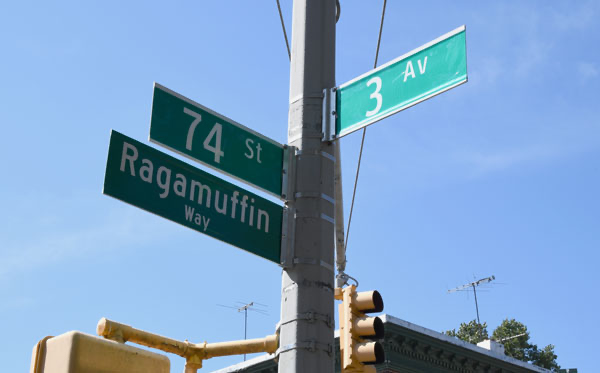
So when Tara and I saw this sign just a few blocks south of our home in Brooklyn — in Bay Ridge — you can understand why I stopped dead in my tracks:

“TARA! What on earth is Ragamuffin Way?!”
I never thought it would lead to the answer to an answer to the question:
Where did trick or treat come from?

Ragamuffin Day formed around 1870, a few years after US President Abraham Lincoln declared Thanksgiving a national holiday. Ragamuffin Day took place on Thanksgiving, and typically involved children going from door to door asking for candy or money in order to draw attention to the plight of the poor, the homeless, and those Least of These Least whom Jesus came to seek and save. Often it was a less-shameful way for them to bring in money for their own starving families. These children were originally dressed in the style of the homeless of New York, with rags and oversized and exaggerated imitations of beggars.

Ragamuffins.
This struggle grew to an even finer point in the 1918 influenza epidemic (see the block quote below).
In further years, the children dressed as sailors, bandits and Disney characters. In the 1930s, the begging tradition was superseded by Ragamuffin parades, a predecessor of Thanksgiving Day parades. As Halloween became popular after the Great Depression, Ragamuffin events became less popular, however children continued the traditions into the 1940s.
Around 1930, The New York Times published several articles in an attempt to end the tradition, that the children would “annoy adults” on Thanksgiving Day with their pleas for candy, money, and gifts. Later that year the newspaper reported that the parades were scarce in New York City, except in its outskirts, where the subway lines end.
By 1937 several organizations began hosting Thanksgiving Day parades to discourage Ragamuffins, where the Thanksgiving parades would also feature children dressed both as beggars and in Halloween costumes. In the 1940s, some of these parades involved around 500 children. The last recorded Thanksgiving Day Ragamuffin parade was in 1956, overshadowed by Macy’s Thanksgiving Day Parade. A Ragamuffin parade on October 15, 1972 in Bay Ridge, Brooklyn, brought about 6,000 children and a crowd of around 35,000, making it the largest Ragamuffin parade in the United States at that time.

In 1918 a deadly influenza epidemic was sweeping across America. The pandemic ravaged families, leaving thousands of children as orphans. But in the tenement apartments of New York City’s Lower East Side, one young girl is determined to keep her family safe. While her mother is sick with consumption, nine-year-old Loretta (Rettie) Stanowski does all the cleaning, washing, shopping, and cooking for her family. To earn money, she washes rags for the rag picker and cleans the halls and stairways of their apartment building.
— Rettie and the Ragamuffin Parade, 2017
But Rettie knows the best way to get even more money is to participate as a beggar in the Ragamuffin Parade that marches down Broadway Avenue on Thanksgiving morning. With the influenza outbreak, quarantines are ordered and large gatherings are banned.
Will the parade be cancelled?

“Cliff came up with the idea of holding a parade for children,” Otey said, explaining that the concept was to help kids. In 1966, long before the advent of the Internet, news that Our Lady of Angles was organizing a children’s parade was spread through word of mouth. “It was a true community grassroots outreach,” Gentile said. The first parade took place on Fourth Avenue. The children marched from 67th Street to Bay Ridge Parkway.
Ragamuffin parades continued in the outer boroughs of New York City after losing popularity in Manhattan. The parades are still held in the area, including in Bay Ridge, held since 1966, Park Ridge, New Jersey, and in Hoboken, New Jersey. Other communities include the Westchester County municipalities Pleasantville and Briarcliff Manor (where the parade has been held for about 30 years).
In September 2016, a street in Bay Ridge was renamed “Ragamuffin Way” in honor of the neighborhood’s 50-year-old tradition.

Frankly, I would love to start a ragamuffin tradition again for the sake of the poor.
If you think we should, write BRING BACK RAGAMUFFINS in the comments and share this with your friends.
So in honor of Ragamuffin parades and trick or treat, I wanted to share from Brennan Manning tonight:
The Ragamuffin Gospel is not for the superficial.
It is not for muscular Christians who have made John Wayne, and not Jesus, their hero.
It is not for noisy, feel-good folks who manipulate Christianity into a naked appeal to emotion.
It is not for hooded mystics who want magic in their religion.
It is not for Alleluia Christians who live only on the mountaintop and have never visited the valley of desolation.
It is not for the fearless and tearless.
It is not for red-hot zealots who boast with the rich young ruler of the Gospels, “All these commandments I have kept from my youth.”
It is not for the complacent who hoist over their shoulders a tote bag of honors, diplomas, and good works, actually believing they have it made.
It is not for legalists who would rather surrender control of their souls to rules than run the risk of living in union with Jesus.The Ragamuffin Gospel is for the bedraggled, beat-up, and burnt-out.
— Brennan Manning
It is for the sorely burdened who are still shifting the heavy suitcase from one hand to the other. It is the for the wobbly and weak-kneed who know they don’t have it all together and are too proud to accept the handout of amazing grace.
It is for the inconsistent, unsteady disciples whose cheese is falling off their cracker.
It is for poor, weak, sinful men and women with hereditary faults and limited talents.
It is for earthen vessels who shuffle along on feet of clay.
It is for the bent and the bruised who feel that their lives are a grave disappointment to God.
It is for smart people who know they are stupid and honest disciples who admit they are scalawags.
People like me and Tara.
People like us and you.
People like the artists and neighbors we love.
Happy eve of the martyrs. Happy eve of the great cloud of witnesses in Hebrews 11. Happy All Saints. Happy All Souls.
Happy eve of the Ragamuffin Gospel.
If you think we should, write BRING BACK RAGAMUFFINS in the comments and share this with your friends.


Comment early, comment often, keep it civil: