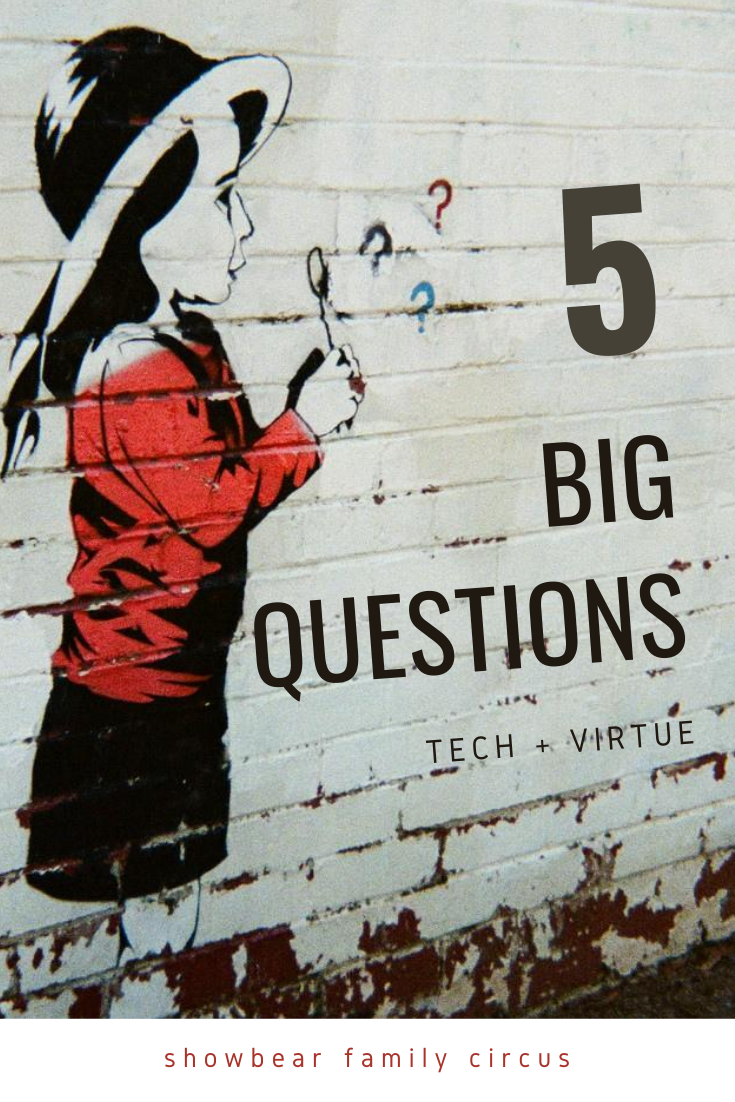
5 big questions

5 Big Questions: Technology and Virtue

We’re starting 5 Big Questions because we had a really vibrant comment section years ago that has since switched to more personal interactions with you all via email. Though we cherish those interactions, we also wanted to encourage you all to dialog with one another as well in the comments.

So we’re going to try 5 big questions today on technology and virtue. In top-level comments, pick your favorite technology and then answer the questions — hash these out with one another:

  1. What does this technology enhance or intensify or make possible or accelerate?
  2. Does this new technology bring back or rescue anything we’ve lost?
  3. When pushed to the limits of its potential, how could this tech degrade its users?
  4. What is made obsolete or pushed aside by the new technology?
  5. What virtues guide you in either the use and adoption or abandonment and dismissal of this technology?

For instance you could start off your comment like:

SOCIAL MEDIA

  1. It enhances and intensifies…
  2. It brings back…
  3. It degrades us by…
  4. It renders ____ obsolete through…
  5. I’m guided in my decision to ____ by the virtues….

or… CLONING

  1. It enhances and intensifies…
  2. It brings back…
  3. It degrades us by…
  4. It renders ____ obsolete through…
  5. I’m guided in my decision to ____ by the virtues….

Pick a tech and we’ll see you in the comments below \/ \/

READ NEXT:  The Sunlit Man cosmere novel by Brandon Sanderson

Be sure to share and comment. And subscribe.

Comment early, comment often, keep it civil:

This site uses Akismet to reduce spam. Learn how your comment data is processed.

  1. tantricdisposition

    The Internet is world-changing technology that’s got out of hand recently. Tim Berners-Lee and others believe it’s turned from its mission of providing a wealth of substantial information and data for largely educational purposes, as well as entertainment and aesthetics, to a place where corporates and govos mess with public minds and squeeze them fascistically to crack open our desires for the purpose of exploitation. There are at least two or three projects under way to replace or offer an alternative to the current Internet model.

    1. Lancelot Schaubert

      What are those alternatives?

      1. tantricdisposition

        Dfinity is one: https://tinyurl.com/y3rc4drq and the other is Tim Berners-Lee’s Solid.

        1. Lancelot Schaubert

          Gotcha, so like mesh networks?

          Let’s ask the 5 questions of that tech: the internet replacer. How do you think they apply?

  2. Mark Reasoner

    We can guide our use of most any new technology by keeping several basic precepts in mind. These might include the “Golden Rule” (as defined in most every culture and religion), Asimov’s Three Laws of Robotics (adaptable to most any new development or invention–particularly the first law) and an old saying my Mom taught me, though I know she didn’t originate it. It says, “Just because we can doesn’t mean we should.” Be it social media, AI or the next great thing, grounding principles like these can help us keep progress on a track.

    1. Lancelot Schaubert

      Talk a little more about ought and could: what’s the difference between what’s plausible and what’s ethical?

  3. tantricdisposition

    I’m with you on the Gold Rule and its availability in all the major religions — the 3 Abes and Beyond. But we have to figure out a way of benignly suppressing the lawyers, who turn simplicity into a footnote and make a virtue of blatherscheissening rule making for the sake of moot court jestering. In other words, Boston Legalese. Asimov’s Laws are similarly fine, so long as we understand the position we start from. The assumption is that we will be in control when the day comes we’ve achieved AI, a ’50s notion. What if we all hook on to a hive mind, as some are now suggesting is where we are heading, and WE become the AIs as a by-product, controlled by algorithms, Sounds far-fetched until you consider more deeply what’s already happening to people and the Internet. “Just vecause we ca, doesn’t mean we should…” True. Just because we can rape Nature, doesn’t mean we should. Nature’s bnig enough to take back the night, and then we’re all [RADIO EDIT].

    1. Lancelot Schaubert

      I’m reminded of the Robin Williams joke: “Shakespeare said step one: kill all the lawyers. But that was before they invented literary agents.”

      That said, what’s the difference between civil law and moral law? And how is legality predicated on natural law? On morality?

      Regarding becoming the algorithms. What do you think about the idea that we shape our tools and then our tools shape us?

      1. John Hawkins

        Our tools and us are one.

        1. Lancelot Schaubert

          Always? How is a man a wheel? How is a knife a girl?

          1. John Hawkins

            I know lots of men who are wheelers and dealers and if you mess with their girl you’ll see the knife. But more importantly, there is no wheel or knife without a man or woman. The prior don’t exist w/o the latter. They’re one that way. And, of course, not “always”. Never said that. Just now. here, and in England.

            1. Lancelot Schaubert

              Oh I agree in terms of efficient causality one way. But how does a knife predicate a man? Or a wheel?

              (Sure, I’m just prodding.)

              1. John Hawkins

                Think panpsychism, consciousness in everything (or nearly) and tools and men coming out of the same prime forms. I was reading the other day an article that suggested that consciousness may have come from a virus, and therefore, tools too are viral-driven extravagances of consciousness. So, in that way,too, but not always, we and tools are shaped as one.

                1. Lancelot Schaubert

                  Sure. Or just classic neoplatonism.

                  But even then: surely we distinguish between one consciousness and another? For how else do we distinguish between your consciousness and mine? Are we not seperate persons? Or do you not believe persons — or individuals or souls or identity or autonomy — exists?

                  Is consciousness physical?

                  And is it logical to base a firm minor premise on a flimsy hypothetical?

                  That aside: certainly it makes for an interesting fiction concept. I’d love to read a story with this premise in the submissions.

  4. Nancy Levinson

    I am not connected to any social media.  I have an iphone, which I rarely use any more b/c I don’t go anywhere.  Oh, here in my LA officette I do go to face time with my granddaughter in Minnesota,
    and I have photos on the iphone for what reason I forget.  

    I have a desktop computer for writing and submitting,  reading news headlines with tears in my eyes and fear in my heart, and  emailing.
    Of course, computers and printers and faxing are  highly advantageous, a far cry from the world in which I grew up banging keys on manual typewriters and making copies with carbon paper.
    Now with the world on fire, I have learned to click on the word “zoom” and connect with family, programs, lectures, music performances, and the like.  As much as this technology is truly helpful, plague-wise, and I call it all not Plan B but Pan Z, it’s better than total isolation.

    BTW, I read newspapers, enjoying morning coffee while page-turning the NY and LA Times.  I use a landline telephone, albeit with a wireless piece that allows me to walk around between three apartment rooms.

    Yes, wireless connections outside are helpful and meaningful for many, particularly for emergency use.  It’s disturbing and sad to see people with faces in their phones everywhere constantly.
    And what all that has allowed for hacking and spreading of lies and outrageousness appalls me.  5G is dangerous.  I fear that the negative far outweighs the good.  Do I need to say Zuckerberg shoveling in the gazillions ?  And do I need to remind of the stable genius now sending out storm-troopers . . .

    Since you took the time to read this, I am going to donate at least a pittance to Showbear.  

    Courage.

    Nancy

    1. Lancelot Schaubert

      Yeah we actually cancelled our internet a month before COVID hit, then had to reinstate it (I’ve talked about quitting social media often on this site). The idea of carbons, though, terrifies me. I often think of how many manuscripts we’ve lost to postal mistakes. Or shipwrecks (a la Paul’s 3rd and 4th letter to the Corinthians). Or fires (library at Alexandria).

      I’d love to go landline. I might at some point, not yet, but getting to paper correspondence would be awesome.

      Curious how you think the questions apply specifically to letter writing and landlines, though…?

      Thanks for the love and the donation. We’ll put it to work ASAP.

  5. Jeff youngblood

    I’m going to lump the internet and social media together because today they are almost inseparable; nearly every site one comes across has a comment section, share button, etc.

    t enhances and intensifies…what’s worse and best about us, and the systems we live in, i.e capitalism.
    It brings back…well I can’t decide if it brings back tribalism or it’s just reflecting what is happening for it’s own reasons, but it definitely seems to intensify tribalism and everything that’s negative about it. It seems to be decreasing compassion, by intensifying our differences. I’m growing more weary of it as it seems things keep spiriling downward into hot takes, virtue signaling and other such primordially driven urges. Everything happens so fast people seem to lose the capacity for reason in the chase for endorphins they get from likes.

    I think most of us fail to understand the fundamental overarching design at play here. Facebook isn’t getting worse so much as it is manifesting the way it was designed. Outrage sells and all of these social media outlets are profit driven. Most of them were designed very irresponsibly. You must constantly be on guard against the very nature of the beast. It isn’t a coincidence when people argue more there then they do in real life. It was designed that way.

    It takes great diligence and fortitude not to fall into the constant traps. And we’ve all witnessed the feeding frenzy that can quickly occur. It amplifies mob mentality on a progressive and often insidious way.

    It degrades us when we fail to realize these dangers and get caught up as a pawn in a chess game run by silicon valley giants. And honestly, if all social media evaporated tomorrow I would wager the world would be a better place. The anonymity and lack of true human contact and superficial validation it encourages are dangerous. As a society it feels like we are caught up in a disease with a definite progression.

    1. Lancelot Schaubert

      Jeff! I’ve missed you brother, how are you? Welcome back.

      Re: enhancing and intensifying — could there be a difference between enhancing and intensifying low-effort comments verses high-effort ones? Low-effort voting verses high-effort voting?

      Re: tribalism — could it possibly bring back unity in some way as well? Or bring back compassion? For certainly stories of empathy and sympathy (Illiad where Priam appeals to Achilles via story) and compassion (stories of the martyrs) are where we get our idea of walk a mile in your neighbors shoes, right? Said in another way, is there such a thing as a cool take? Cold-headed take? Cold-blooded take that’s reasoned and studied and reflective? Or perhaps Socratic?

      When you say that’s how Facebook is designed, what do you have in mind? Any article or citation?

      I think you hinted at this with your feeding frenzy metaphor, but to ask: are these truly arguments or fights?

      What would the progression be of this disease?

  6. Karl

    More and more I wish we could roll back time to before any sort of tech was created. By that, I see tech as any tool. However, I’m speaking mostly of tools that require the utter destruction of the earth and habitats (such as coal, lithium mining, etc.) I have a very hard time justifying any exploitation of any human, other sentient being, or the earth, for the sake of any advancement. At that point, I do not view it as advancement.

    1. Lancelot Schaubert

      Overlaying the five questions on that, which techs do you think have value and virtue?

      1. Karl

        Most tech can produce something of value for many people. However, again, even if a billion benefit, does that outweigh even one being exploited?

        1. Lancelot Schaubert

          And… I suppose it brings into question the nature of value: what is value? What’s valuable? How do you arrange what’s more or less valuable?

        2. Lancelot Schaubert

          There we go: and that’s the real question — what’s the value of a single person?

  7. discerningksb

    I’m a bit late to the party here – but have been thinking a lot about my electric stove lately. We had to replace it recently and it made me both appreciative of the gas stove top that got us through the non-oven phase – and the decided negatives about gas.
    Obviously, an oven (in this case electric) enhances our ability to cook food without thinking about it too much – set the timer and go. And you can go quickly or slowly depending on the temperature and your schedule that day. I tend to love the slow simmering of a good brisket.
    Food simmering brings back those smells of childhood – off a grill or in a stove – either way, it warms our hearts.
    But electricity does spur a claim to energy that perhaps is not ours to claim – should we divert a waterfall or river to produce power for our brisket? Maybe – but hard not to do harm there – salmon and all that.
    Should we take coal from the ground creating irreparable harm for our own poser – nope! The whole nuclear approach is clearly flawed.
    But hope springs in solar – to drive the electricity of Edison. Across the country – like minded restauranteurs are switching from gas stove tops to electric ones – challenging their patrons to note the difference. BUT – solar panels are made from silicon, metal and glass – all extractions that perhaps we again – have no right to extract or reroute. Plus, heating large volumes of quartz sand (and where did that come from, what beach or quarry?) to 1800 degrees C – is a whole other rabbit hole.
    Conclusion – no technology is without the sacrifice of nature or beyond – as Karl said – at the point where exploitation occurs – is it advancement – or simply hubris?
    My two cents. KSB

    1. Lancelot Schaubert

      To that degree, what’s the difference between “man’s triumph over nature,” which has yet to happen, and “one man’s triumph over another man with nature as the instrument” ?

  8. Lancelot Schaubert

    Any other thoughts? Or any new thoughts on checking back on this list?


Please comment & share with friends how you prefer to share:

Follow The Showbear Family Circus on WordPress.com

Thanks for reading the Showbear Family Circus.
  1. Like this, very noir. Can smell the stale smoke and caustic aroma of burnt coffee. That mewling grunt of a…

  2. Years ago, (Egad, 50 years ago!) I was attending Cal (Berkeley) I happened to be downtown, just coming out of…

Copyright © 2010— 2023 Lancelot Schaubert.
All Rights Reserved.
If we catch you using any of the substance of this site to train any form of artificial intelligence, we will prosecute
to the fullest extent permitted by any law.

Human children and adults always welcome
to learn bountifully and in joy.