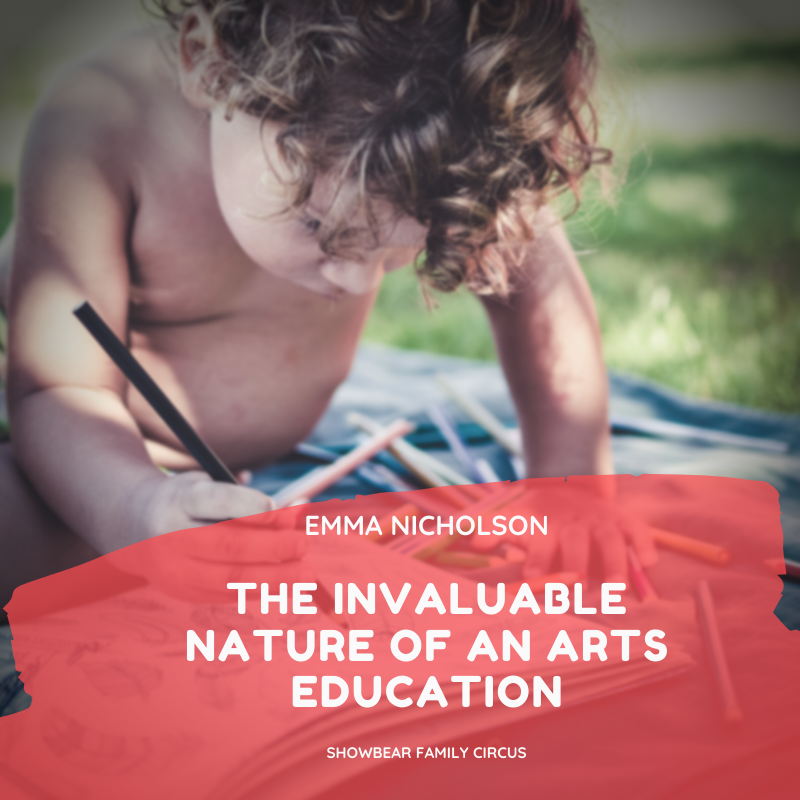
As children, we draw pictures to tell stories. The scribbles, lines, and outside-the-line coloring seem merely arbitrary; a dog next to a house with a tree, a stick figure creation, or the classic unproportional family portrait. We come home from school covered in marker ink and with heads full of stories. We sing songs to learn new things: the alphabet, the states, US history. And we pretend; we put on the facade of another character-a princess, a monster, a villain. As children we are given an endless stream of opportunities to be creative that lead us to imaginative places beyond our known world.
But like any good Disney movie, we grow up. And growing up means moving on. Being sucked out of the mystical, fantasy of youth and dropped, no-thrown into adolescence, stripped of creativity. Maybe it is not that dramatic. But we grow up, and there is noticeably less of a push for that creative spirit. Instead of telling stories, we analyze them, and instead of pretending, we are jolted by the unyielding silhouette of reality.
In order for children to have opportunities to express themselves, gain the mental benefits of art, and display creativity, it is necessary for schools across the United States to fund sufficient arts programs. It is high time that the country begins to recognize the impact that an arts education can have on students, because it is invaluable.
I was lucky enough to go to a middle and elementary school with thriving arts program; art and music classes multiple times a week, monthly assemblies that usually involved a class song, and a gamut of artistic extracurricular opportunities. Even now, my high school has an enriching arts program with classes offered in all sorts of visual arts, theatre, music, writing, and more.
It is no question that this rich artistic engagement, both inside and outside of school has helped to shape who I am. But these days I am starting to see more and more schools, specifically high schools that lack the arts program I am lucky to experience. In fact, a study done by the Americans for the Arts Organization concluded that almost two thirds of teachers across the US report that their school lacks a sufficient art department.
Why would children be deprived of such opportunities that possess not only immediate benefits, but the long term benefits that can help enrich their lives? It seems self explanatory that educators would aim to improve educational experiences in any pathways possible. Usually, it is because of budget issues and lack of funding for these programs, which has come to light recently and grown to be a national issue.
In February of 2018, President Trump announced his financial plan for the 2019 fiscal year that included major budget cuts for the National Endowment for the Arts–an independent federal organization responsible for funding and promoting arts education in the United States. After its establishment in 1965, the NEA became one of the three major sources of funding for the Arts in the United States. This proposal for 2019 was based upon the idea that the President would eventually shut down this federal organization, as he believed it was “not a vital part of arts funding.” (Washington Post). Since that point, the proposal has gone through a variety of changes. But nonetheless it has brought to light questions about the real importance of art in schools.
The truth is that “the arts ” is a blanket term covering more than drawing and painting. They are dancing, singing, drama, poetry, writing, and music. And each one of these categories has their own unique benefit to the life of students not only in the classroom, but in the future, as they go on to become the next generation of leaders and educators for our world.
Participation in the arts has been proven by the National Endowment of the Arts, to increase academic achievement in subjects like math, reading, and writing. Theatre helps to understand complex social relationships, dance encourages creative thinking, and visual arts improve organizational skills and image reasoning. Not only can this increase academic performance, but these activities have been proven to increase graduation rates. In a 2009 report by the Center for Arts Education, schools who gave students more opportunities to be involved in the arts and had more outlets for creativity saw a greater rate of graduation than those who did not have these opportunities.
The statistics are there: participation in the arts has an immense impact on individuals beyond what is visible. I can truly say that I would not be the person I am today without the enriching art education I received both inside and outside of school. Ballet has taught me discipline and rigor of a professional work environment. Theatre has encouraged me to enjoy being a background character-it can be the time of your life. And singing, dancing, and performing have taught me the power of storytelling; the joy in sharing a story that is different from your own. Stories that are unique and powerful to an audience. I’ve learned a lot from visual art too-I have learned that I am great at the art of stick figures and coloring outside the line (no artistic talent there!) And writing, a passion of mine, has taught me that words can speak louder when they come from the heart.
But most importantly the arts have taught me that when you have that spark, that love of creativity, the bliss in expressing yourself, it means more than what meets the eye. It is more than what you see in a performance, in an art piece, in a show. It is the feeling that you get doing what you love, telling your story, putting yourself out there, and allowing yourself to be vulnerable as you share your craft with the public.
And when you have that spark, you can never let go. I will fight for the kids who have it, but cannot reciprocate this into art. The kids who do not have access to what I have, the kids who long to express themselves in ways beyond the realm of daily life. The kids who went to schools that were unable to fund these activities.
By cutting funding for art programs in schools, students are being deprived of a chance to not only reap the benefits of these programs, but they are being deprived of a chance to tell their story. Though we all start with scribbles, a continued arts education has the possibility to open new doors in a way that no math problem ever will.
Featured Download: CLICK HERE to unlock the methods for preparing your life for creative inspiration and visionary change.


Comment early, comment often, keep it civil: