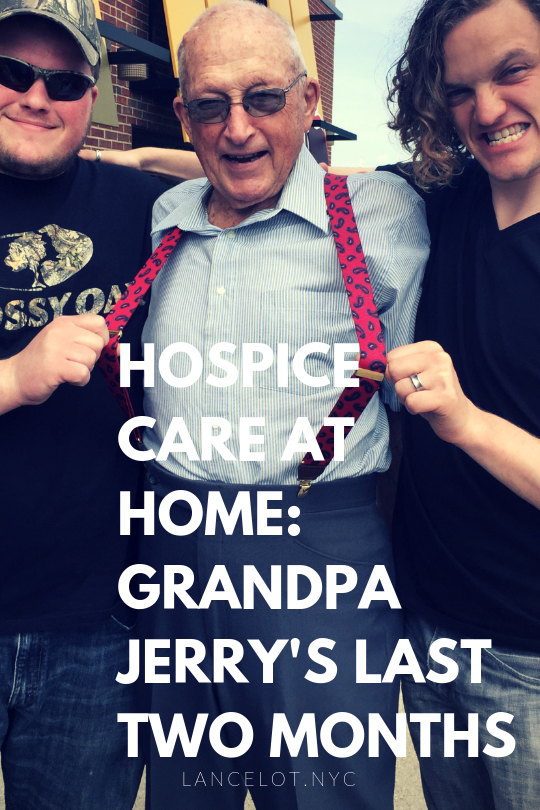

In keeping with remembering my grandpa Jerry, I wanted to live blog a little about his last two months here on hospice care at home and the funeral services, starting from today, moving towards the day he died, and then moving backwards over the last few months. I’ll update it every day until I can’t anymore. The main reason I’m doing this is that a ton has happened and I can type faster than write longhand and don’t have as much time as normal to journal in the midst of the chaos. So I’m doing it here for me and some family members.
It’ll be less raw writing this than in a journal, but more raw than my normal post, but then again I’ve always talked about writing more life posts on here, so here we go:
Thursday.
December 27th. Third day of Christmastide.
Funeral was beautiful — Phil came back to Illinois early to do the service (grateful for him). Aunt Pam said some really kind words and we played several songs that really made it hard to keep it together, both of which are embedded below, but one I’d never heard before:
From Wiki:
Beulah Land is a well-known gospel hymn written by Edgar Page Stites (1836–1921) in either 1875 or 1876. The hymn, Stites’ most popular, is set to music written by John R. Sweney (1837–1899). The hymn concludes with the chorus:
O Beulah land, sweet Beulah land!
As on thy highest mount I stand,
I look away across the sea
Where mansions are prepared for me
And view the shining glory shore
My heaven, my home forever more.
The hymn derives from the King James Version of Isaiah 62:4; “Thou shalt no more be termed Forsaken; neither shall thy land any more be termed Desolate; but thou shalt be called Hephzibah and thy land Beulah; for the LORD delighteth in thee, and thy land shall be married.”
The verse is in reference to the return of the Hebrew from their exile in Babylon in which the Hebrew shall no longer be called Forsaken, but Hephzibah (My Delight Is in Her), and Jerusalem shall no longer be called Desolate, but Beulah (Married).
The idea the hymn presents that Heaven can be seen from Beulah land comes from John Bunyan‘s Pilgrim’s Progress in which he states “Therefore it is, I say, that the Enchanted ground is placed so nigh to the land Beulah and so near the end of their race [i.e. Heaven].”

It’s basically the wedding of the land itself. And as someone who lives in a marsh, in a broken land, in Brooklyn — that has a deeper Sehnsucht than most. Grateful Grandma picked that one.
I left a pen in his tomb because no matter how much I write, I can’t get it right, and the lyrics of Saturn say, “I tried to write it down, but I could never find a pen.” So I gave him a pen to be buried alongside because he asked me to “build the story well,” as well as he built houses, and I’m trying to learn how to do that better and better as the years pass. My pen for his sword. My pen for his hammer. My pen for his tale. My life for his life.
Dad and Lauren and Tara and I sat outside FCC listening to Saturn and then this song:
And 400 geese flew over in wave after wave after wave of flying Vs. Lauren said, “The tide’s coming in.”
Dad said, “Winter is coming and they’re flying south.”
“When did grandpa used to leave for Florida?” I asked.
“December 27th or 26th, right after Christmas.”
“So today?” I asked.
“Would have been today,” he said.
“Winter birds, still heading south,” Tara said.
We got the pictures together and shared some more and said our goodbyes, then went and watched Mary Poppins Returns, which ends with a tap dance routine from a 90-year-old Dick Van Dyke. He exuded grandpa’s joy and kindness. Seems like everything reminds me of him…
Wednesday.
December 26th. Second day of Christmastide.
Day of the wake and visitation.
8pm — Wake over. Watched A Quiet Place with my brother and sister. Seemed appropriate.
4pm — Visitation / Wake. Lots of folks I’ve not seen in years. Heard even more stories I’d never heard before like how Great-Great-Great Grandpa Schaubert had kept telling his neighbor he’d planted turnips even when he knew his neighbor had planted celery in his garden. His neighbor never believed him so Great-Great-Great Grandpa pulled up the plants one night and resowed turnips just to confuse the guy.
2:30pm — Dad and I ran the pictures and easels over to the church. I saw pictures of all four generations of us that I’d never seen before and pictures of pranks I didn’t know he’d pulled.
12:44pm — I really don’t want to do this or face this. Tara’s going to be sorting photos for everyone. She just made breakfast. I’m struggling to even think about anything else — Peter just called to comfort me and talk through things. He’s one of the kindest, most thoughtful of men.

Tuesday.
Christmas Day.
I woke up late and didn’t take a shower or change out of my pajamas until five in the evening or something. I stressed about the dogs most of the day (really didn’t want to bring Echo, but had few alternative options at the time). I made breakfast and got irritated with people and apologized — the dogs just stress me out so much. I’ve been on edge the whole week waiting for the dogs not to get along or for Echo to hurt a kid or bust open someone’s trash can or something.
Mom suggested I turn on some music. So I turned on this:
And lost it.
I braced myself both hands on the stove and wept as the sausage burnt. And I played it over and over again. I tried to write it down, but I could never find a pen. I’d give anything to hear you say it one more time: that the universe was made just to be seen by my eyes.
Never find a pen. I feel that way. That I’m spilling ink on tens of thousands of words for this man and I’m nowhere closer to explaining how beautiful and rare it was for him even to exist — the raw fact of his existence and consciousness in the midst of the void. And I can’t write it down. I can’t find the pen to write it down right.
Every time I tell a story, a Ross or a Virgil or a Steve will show up and tell me something I never knew about my grandpa, always insightful and always charming and always poignant and always down-to-earth in its immediacy.
And I’m realizing the journey of the alone to the Alone is one each one of us can only take ourselves, further up and further in to the divine. That God alone knows our true names, our true identities, and that if you ever in marriage or family or friendship or with your neighbors think that you’ve understood a person and know them, you’re lying to yourself:
You can never, ever know a person fully, deeply, to the bottom of everything with nothing left to explore.
There’s an infinite depth to the human soul that should make you infinitely curious about every person you ever meet.
Because you’ve never met a mere mortal. Only everlasting men and women.
We ate breakfast and the rest of the family came over. We exchanged gifts — vibrating pillows and inkwells and books and inflatable punching bags — and auditioned for Family Feud.
My mom and I stayed up late having a very emotional, very honest conversation about family and the work family takes to get right.
Monday.
December 24th, Christmas Eve.
Last night, I stayed the night so grandma wouldn’t be alone. I didn’t fall asleep until 5:30 am after tossing and turning and having fever dreams. I wrote Tara a long text and was able to fall asleep. Terri Larimer, my first music teacher and drama instructor, came over with muffins. I didn’t know she still lived in the area — haven’t seen her in ten years or more.
I wrote a bit on here and posted the short story, elegy, and obit.
I cleaned out a good chunk of his closet with grandma, mainly because she like me and my dad and many of us struggles with getting rid of things, but also because grandpa and I wore the same size and both like pearl snap western cut shirts. I like them because I always thought most buttons looked tacky and they remind me of polos, which are the height of my experience with the bourgeoisie here and elsewhere. So I prefer the pearl snaps as a classy form of blue collar wear, as well as for something to wear when I’m singing a folk concert, but mainly because grandpa wore them. I wanted one. She gave me twenty.
Dad came over with his dog to relieve us. Pun intended. I called him while
I missed the first Christmas Eve service. Then my bride really wanted to go with mom and Keith and the same panic set in about seeing everyone before the funeral. I let them walk into the church and I walked an hour instead through country roads in blackest night with stars overhead, past the tiny county airport, through beer can alley.

beer can alley
The osage orange trees look much creepier at night, walking through them, very Sleepy Hollow and there are tons of osage oranges to trip over. Lots of mud. I got a coffee at the gas station at the end of the road to get me through the rest of the way and asked the guy if he minded if I sipped it inside for awhile. He rolled his eyes at me and shook his head and waved his hands. He seemed irritated that I would ask such a thing, maybe because it was Christmas Eve. So I sipped a couple of sips and left.
We sang our Christmas parodies and ate spironi and told stories about why I got my toenails painted with my grandma and exchanged gifts. We talked for a time and then everyone left.
We played codenames and my mom and I hit the assassin both times, which has never happened, so maybe that says something about how well my mom and I communicate?
Sunday.
December 23rd, eve of eve.
I originally wanted to go to service both at Evergreen and FCC, but I couldn’t stomach the thought of seeing everyone I ever knew growing up here before the visitation. It’ll probably be hundreds, maybe thousands of people on the 26th, who knows? The funeral home said to plan for four hours. But like grandma, I just couldn’t stomach seeing everyone yet.
And, to be honest, I haven’t slept more than five hours or so every night since I got here. So I crashed and slept until 11am and barely got ready enough to meet mom at Village Garden for breakfast with an old friend — an old Sunday School teacher and retired police officer — and eat cinnamon swirl french toast with Tara.
We left from there and went to the house to watch “the game” (which, by the way, I always thought was a funny phrase since everyone in the room is almost always following a different game). Some folks came over with fried chicken and whatnot and I was able to relieve Aunt Pam of the vigil of staying the night with grandma. Got my CPAP and stayed up until about ten playing Yahtzee with my sister, watching White Christmas with my dad and grandma (which Tara and I live-stream with Mark and his wife every year).
Grandma got tired and we prepped for bed. I didn’t fall asleep until 5:30am and texted Tara at 5 about it. Slept until about 8:30am and got up to write a bit and eat some donuts.
Saturday.
December 22nd, full moon.
I came over late after my brother bought me a gyro at this hole in the wall in Mt. Vernon — definitely the best gyro in SO iLL — and me and two of my 40-year-old cousins and my aunt and uncle munched for dinner on some fried chicken that my cousin’s father-in-law (a demo derby driver and mechanic) had brought over. They ribbed me — like everyone here ribs me — for living in New York, regardless of what I think or do or feel. It’s mostly harmless fun. Mostly.
I laughed often and took it in stride.
Before that I came over with wet hair. I had just eaten lunch at Village Garden along with a retired cop and his wife, a former preschool teacher, and my mother and step father. Tara and I both had cinnamon swirl french toast, something like the grown-up, full service breakfast version of the most absurd breakfast cereals ever invented by General Mills.
Prior to that, we had been asleep. We’d gotten back at four in the morning and gotten to bed at five in the morning, so I slept like I used to sleep in highschool — I slept in until eleven without a second thought. In retrospect, that wasn’t that much sleep at all: six hours.
My dad drove us back at four in the morning and he said he wanted to hear this at the funeral:
And then we saw the clouds that I mentioned earlier, the winter solstice full moon and the clouds spiraling heavenward. It looked like Dante’s paradise, rank on rank of angels ascending in the second and third and fourth heaven:

My brother’s phone was off so my aunt and uncle sent me and my cousin over to my brother’s house to try and wake him but he would not rise. I shouted. I banged. I threw rocks at his window and shouted “Oh Romeo!”
He wouldn’t wake. And I wasn’t about to break into my brother’s house — he’s the kind of guy who has more guns than limbs to holster them on.
We came back and after the Ed Rankin and the funeral guys came to take my grandpa’s body, my cousins and uncle and father and I all started deconstructing the medical bed so that grandma wouldn’t have to see it in the morning. We loaded up Bandy’s medical service van and shared some more memories. By that point it was three in the morning and Dad and I needed to get back to the house.
Friday.
December 21st. Winter Solstice.
Prior to that, grandpa was alive and struggling, as I hinted at in the elegy I wrote. I read him from Psalm 25 forward (having already read from Psalm 8, Psalm 23, Psalm 139, Psalm 1). I didn’t do it as naturally as I would have liked, but in those situations there are two kind of people. Those who avoid death and those who memento mori, who, as John Eldridge says:
Resolved, to think much on all occasions of my own dying, and of the commoncircumstances which attend death.
Or as St. Augustine said:
And as in the daily casualties of life every man is, as it were, threatened with numberless deaths, so long as it remains uncertain which of them is his fate, I would ask whether it is not better to suffer one and die, than to live in fear of all? I am not unaware of the poor-spirited fear which prompts us to choose rather to live long in fear of so many deaths, than to die once and so escape them all; but the weak and cowardly shrinking of the flesh is one thing, and the well-considered and reasonable persuasion of the soul quite another. That death is not to be judged an evil which is the end of a good life; for death becomes evil only by the retribution which follows it. They, then, who are destined to die, need not be careful to inquire what death they are to die, but into what place death will usher them. And since Christians are well aware that the death of the godly pauper whose sores the dogs licked was far better than of the wicked rich man who lay in purple and fine linen, what harm could these terrific deaths do to the dead who had lived well?
On the spectrum of possible deaths, you get one — why worry about them all? This helps us lean in when friends and family and even foes are dying before us. But even this and pastoral training did not help me much. Having worked as a nurse’s aid helped me be near him, but what helped the most was my bride.
Who had done hospice for awhile.
See Tara saw so many people running away from death when we lived in Joplin that she decided to run towards it, not in a suicidal manner but as one would run into a battle worth staking one’s life upon. She ran towards hospice care to give dignity to the dying.
And she learned a ton.
For instance: the hearing is the last thing to go on someone who’s dying. Perhaps it’s because it’s a passive sense — it doesn’t require musculature to work, but rather tiny bones and a piece of skin. Perhaps it’s because it takes so little blood — most of the ears are cartilage and skin and nerves. Perhaps it’s because the nerves are so close to the brain. For whatever reason, the hearing goes last. So a dying person can hear everything: they become less and less corporeal beings and more and more like the watchers of old.
So Tara learned that they need to be read too like infants, sung to like infants, prayed over like infants, encouraged, kissed, and told you’re near them. And they certainly need less talking about them like they’re not in the room.
She’d prompt me to read scripture or sing hymns or what have you and I’d remember and go over and sing to him old traditional folks songs:
And then I remembered the story from the novel I’m working on that he told me. Remember, he and I were trying to tell the story exactly as it went down, warts and all. Newest version goes like this:
Marionette went to the Carlyle prom with a boy that year. A senior. Norm’s son. Beth hand sewed her a dress out of really nice fabric. We turned that dress into a Halloween costume in later years.
Norm’s son came by during the preparations, and Remmy looked him up and down and then left the room to let them talk. When the boy’d left, Remmy came back in and said, “Mary?”
“Dad?”
“That boy don’t look very good.”
“You need to wear your glasses,” she said. “He’s handsome.”
“He’s the son of a barber. He ain’t going to amount to anything.”
She got mad.
That kid proved Remmy wrong, too. That kid amounted to something. That kid became a barber.
But the barbering came later. Before then, that boy got distracted by the desire to be a public servant. Which was code for elected official. Which was code for whatever Texaco wanted him to be.
At about that time, Remmy had to be in the Junior Chamber of Commerce summit up in Chicago. At first, Pete Taylor and Remmy decided they was just the two of them gonna go. But then they thought about all the fun they could share, pranking and making a ruckus and decided they wanted the guys in Bellhammer and Salem and Carlyle all to go up together. So they rounded up the sharecropper side of the street and some of the other boys.
Oh they dressed up something fierce.
Tan shoes. Pink shoelaces. Polka dotted vest and a purple hat band.
Man oh man.
Anyhow, they dressed like what they thought that song was saying, you know the song that lists all that stuff. Dodie Stevens sang it. So they went to the flower shop and got a purple piece of ribbon and put it on their hats, and Beth made some vests and they put pink shoelaces with some tan shoes and wore it all on the train to Chicago.
They shouted about it like a bunch of hooligans.
Everyone wanted to give them some cigarettes to advertise for them, something to put in their vest. Local rollers. And county rollers. And then state rollers asked. And Phillip Morris called when they heard about it and asked Remmy to put some of their cigarettes in his pocket, and Remmy said, “Your cigarettes are made out of horse shit and alfalfa.”
And Pete Taylor said, “There’s not a damn bit of alfalfa in them.”
They went with some local brand and asked them to get paid to advertise, and the rollers said yes and paid them all enough in cash that they pretty much got their meals for free.
Then at O’Fallon, twelve other guys got on with tan shoes, pink shoelaces, polka dotted vests, and purple hat bands. They all laughed and went together — a mob right out of a vaudeville act — up to Chicago for the Junior Chamber of Commerce summit. And Pete Taylor and the boys played all kinds of tricks on that other crew.
Well they got up there and settled in at the YMCA, Remmy and his Merry Men, and across from them was that barber’s boy, who didn’t look very good and especially not that he would someday amount to a barber himself. That kid was out and about going into those convention rooms and asking them all to vote for him. He hoped to work that whole crowd, but somewhere in there Pete Taylor found out the kid wasn’t much of a drinker.
Well they bought screwdrivers, sipped them, set them down on the piano near where the kid was talking, and walked away. Remmy saw the kid seeing them there, and since everyone else had a drink in his hand he grabbed one thinking it was orange juice or something and then walked around with it in his hand, sipping it from time to time. When it was gone, he put one down, came back to the piano, had another, and so on.
Remmy came up to him halfway through and said, “Hey son, how’s the crusade going?”
“Well Texaco sponsored me, but I’m not supposed to say that. Gave a bunch of money to the Army Corp of Engineers again, but I’m not supposed to say that either.” He sipped.
Remmy was mad, then. Not at the boy, but at Texaco. He’d show that company what he thought of their candidate. He bought a Bloody Mary. Pete Taylor put extra, extra vodka in it. They gave it to the kid at the next place and told him, “Normally they just drink these in the morning.”
“Is it very strong?” the kid asked. He was pretty deep. “I can’t have much more.”
Remmy said, “Try it and see if it suits you.”
The kid tried it. It suited him fine.
They kept walking the town and getting him drunker than a skunk. They got him back to that YMCA finally, careening down that hall like the old milk wagon when it’d lost a wheel the year before Remmy’d left and Daddy John had shouted, both of them like Bloody Williamson. And when that boy laid down in the hallway, he went right to sleep. So they got a big old king-sized sheet, they rolled him up like a big old burrito, and Remmy carried one end and Pete Taylor carried the other.
They took him six rooms down and let him lay there all night.
Big shot wanted to be Texaco’s public servant. So they just sent him back to barbering, where he belonged.
So I played him the Dodie Stevens song. When I did, he couldn’t really talk — throat was parched like he’d walked through the desert carrying a broken horse on his back — but he said, “Oh! Ohhh!”
Earlier than that I prayed over him and told him that sometimes people need some privacy away from family in order to die in peace and that we were going to dinner and we’d all be okay. The hospice told him the same. He passed a few hours later.
We’d been at my cousin’s house playing games and eating ribs, a Christmas tradition he started for his employees along with pork loin. Dad made jumbalya and Tara made this crazy salad:

Uncle Steve had me say a few words about rejoicing with those who rejoice and mourning with those who mourn and how sometimes we just have to both celebrate and cry all at the same time and that’s okay. I pointed out how the White Which made it always winter and never Christmas.
It was Winter Solstice, after all, the darkest night of the year. But after that night, more and more light comes into the world. That’s why we light candles both at Hannukah and Advent: Epiphany is on the way. Light is coming. And on Christmas, the light arrives. Matt Otey said it well in his Old Man Chris story.
We got there later in the day — dad had made us a nice lunch and we’d gotten coffee. Or maybe that was the day we got sub sandwiches and I ate too many salt and vinegar chips?
It blurs together at some point.
Thursday.
December 20th.
Dad and I went with Lauren and Tara to watch The Mule and Dad and I both felt struck by the theme of comparing our generation of cell-phone addicts to dad’s generation of guys that wanted to wander and have all of these experiences and make all this money and ignore their family. We were struck because the solution is the same: spend time together.
We ate ate some sandwiches and had honest conversations about how to be better at building relationships and time together.
Tara had suggested I play him some Christmas music, so we picked up my brother’s guitar from his house. Somewhere in playing over grandpa’s deathbed I lost my brother’s favorite purple pick. It’s probably buried in the hospital sheets waiting to be unearthed in the fresh bed of a child with leukemia who always dreamed of learning guitar — a sign, a sign.
But I played him my Christmas song, Hope for Soon:
…as well as a bunch of Christmas songs. The day before I’d read him the start of Tale of Two Cities, which sat on my Grandma’s shelf:
Wednesday.
December 19th.
It was the best of times,
it was the worst of times,
it was the age of wisdom,
it was the age of foolishness,
it was the epoch of belief,
it was the epoch of incredulity,
it was the season of Light,
it was the season of Darkness,
it was the spring of hope,
it was the winter of despair,
we had everything before us, we had nothing before us, we were all going direct to Heaven, we were all going direct the other way— in short, the period was so far like the present period, that some of its noisiest authorities insisted on its being received, for good or for evil, in the superlative degree of comparison only.
There were a king with a large jaw and a queen with a plain face, on the throne of England; there were a king with a large jaw and a queen with a fair face, on the throne of France. In both countries it was clearer than crystal to the lords of the State preserves of loaves and fishes, that things in general were settled for ever.
It was the year of Our Lord one thousand seven hundred and seventy-five. Spiritual revelations were conceded to England at that favoured period, as at this. Mrs. Southcott had recently attained her five-and-twentieth blessed birthday, of whom a prophetic private in the Life Guards had heralded the sublime appearance by announcing that arrangements were made for the swallowing up of London and Westminster. Even the Cock-lane ghost had been laid only a round dozen of years, after rapping out its messages, as the spirits of this very year last past (supernaturally deficient in originality) rapped out theirs. Mere messages in the earthly order of events had lately come to the English Crown and People, from a congress of British subjects in America: which, strange to relate, have proved more important to the human race than any communications yet received through any of the chickens of the Cock-lane brood.
France, less favoured on the whole as to matters spiritual than her sister of the shield and trident, rolled with exceeding smoothness down hill, making paper money and spending it. Under the guidance of her Christian pastors, she entertained herself, besides, with such humane achievements as sentencing a youth to have his hands cut off, his tongue torn out with pincers, and his body burned alive, because he had not kneeled down in the rain to do honour to a dirty procession of monks which passed within his view, at a distance of some fifty or sixty yards. It is likely enough that, rooted in the woods of France and Norway, there were growing trees, when that sufferer was put to death, already marked by the Woodman, Fate, to come down and be sawn into boards, to make a certain movable framework with a sack and a knife in it, terrible in history. It is likely enough that in the rough outhouses of some tillers of the heavy lands adjacent to Paris, there were sheltered from the weather that very day, rude carts, bespattered with rustic mire, snuffed about by pigs, and roosted in by poultry, which the Farmer, Death, had already set apart to be his tumbrils of the Revolution. But that Woodman and that Farmer, though they work unceasingly, work silently, and no one heard them as they went about with muffled tread: the rather, forasmuch as to entertain any suspicion that they were awake, was to be atheistical and traitorous.
In England, there was scarcely an amount of order and protection to justify much national boasting. Daring burglaries by armed men, and highway robberies, took place in the capital itself every night; families were publicly cautioned not to go out of town without removing their furniture to upholsterers’ warehouses for security; the highwayman in the dark was a City tradesman in the light, and, being recognised and challenged by his fellow-tradesman whom he stopped in his character of “the Captain,” gallantly shot him through the head and rode away; the mail was waylaid by seven robbers, and the guard shot three dead, and then got shot dead himself by the other four, “in consequence of the failure of his ammunition:” after which the mail was robbed in peace; that magnificent potentate, the Lord Mayor of London, was made to stand and deliver on Turnham Green, by one highwayman, who despoiled the illustrious creature in sight of all his retinue; prisoners in London gaols fought battles with their turnkeys, and the majesty of the law fired blunderbusses in among them, loaded with rounds of shot and ball; thieves snipped off diamond crosses from the necks of noble lords at Court drawing-rooms; musketeers went into St. Giles’s, to search for contraband goods, and the mob fired on the musketeers, and the musketeers fired on the mob, and nobody thought any of these occurrences much out of the common way. In the midst of them, the hangman, ever busy and ever worse than useless, was in constant requisition; now, stringing up long rows of miscellaneous criminals; now, hanging a housebreaker on Saturday who had been taken on Tuesday; now, burning people in the hand at Newgate by the dozen, and now burning pamphlets at the door of Westminster Hall; to-day, taking the life of an atrocious murderer, and to-morrow of a wretched pilferer who had robbed a farmer’s boy of sixpence.
All these things, and a thousand like them, came to pass in and close upon the dear old year one thousand seven hundred and seventy-five. Environed by them, while the Woodman and the Farmer worked unheeded, those two of the large jaws, and those other two of the plain and the fair faces, trod with stir enough, and carried their divine rights with a high hand. Thus did the year one thousand seven hundred and seventy-five conduct their Greatnesses, and myriads of small creatures—the creatures of this chronicle among the rest—along the roads that lay before them.
Oddly relevant for me and him.
Somewhere in there I stood over him and his right eye shot open and he said, “Which one am I looking at?”
“Your grandson Lance.”
“Oh. Oh good,” he said. “Goood.”
I realized he’d been having a little trouble hearing and was talking the whole time, just in whispers because his vocal chords were no longer strong enough to fight past the dryness. So I leaned in close. “You need any water.”
“That’d be nice,” he said.
We gave him a tiny sponge. He’d choke on too much more.
“You need anything else?”
“I wouldn’t know what it would be,” he said. “Am I going home soon?”
“You’re at home. We brought you home,” I said.
“Oh I forgot,” he said. “I’m getting confused.” He winced some from the pain.
I read to him some more. I told him I loved him. He whispered as much back. It would be the last thing he said to me, I think.
I tried to give grandma something to do to take her mind off it for awhile by having her teach me to sew some buttons on my black overcoat, which has lost three of the big buttons in four years.
We got the guitar from my brother’s house for the next few days and ate hot wings at the Elks. I drew a line drawing of my grandpa for my aunt.
Tuesday.
December, 18th.
We transferred grandpa from Salem Township hospital. I got a BLT and chips and a coffee for $3 — I didn’t know I could still do that anywhere in the country. I’ve never seen the Salem reservoir from the new window.

A massive raven outside looked on at us and fiddled with a walnut. Grandpa used to play stickball with me and with those. He’d collect them out of the walnut trees in his yard and then we’d roast them and eat them fresh.
We got him transferred in the ambulance and they got him settled in after a day of another Schaubert we hadn’t met before installing the cable. This may seem an irrelevant detail but since there are only 300 of us in the states, we’re all related somehow. His grandpa worked the same farm in Boulder, Illinois that I feature in that novel grandpa Jerry and I worked on together.
Then grandma’s foot caught on the carpet and I couldn’t get my beer and phone set aside quick enough. One of my hands caught some of her weight but my uncle rightly worried about a break, so he got the number of the new ambulance guy from one of his employees and said, “Bryce. I’ll need you to come back, okay?”
“Okay. What for?”
“Mom fell and we’ll need you to not run the siren and lights so as to embarrass her.”
So we didn’t move her other than rolling her from her side until face up. And dad had pulled out all of these old Super 8 slides and so I pulled some up and held them up to the boob light on the ceiling and asked her which was the grand canyon, which was grandpa, and so on until the ambulance showed up. I pretended like the pulse ox beeps were censoring her out from cussing. Ribbing her and joking like that helped her relax and we got her x-rayed and home, no broken bones.
Dad and I sat up talking until two or three, like most of the week. We talked about how grandpa walked all over this town, talking to people and we fretted about what was to come.
November.
I couldn’t come home, but Dad kept calling me worried as grandpa moved from hospital to hospital, fought to get out and get home on hospice, fought people who wouldn’t let him and the one thing he kept saying was, “I’m calling my grandkids: they’ll bust me out of this joint.”
October.
Someone in our homegroup had a car that only had 1,000 miles on it last year because… New York driving. And the sensors went asleep, so it needed a road trip to wake them up. So they gave it to us and I’m eternally grateful to them for that.
Grandpa had just gotten an emergency airlift to the hospital and told me, when I called him, to come when I can. Tara and I drove back through Appalachia and I read Narnia to him in the hospital. “That’s a pretty good story,” he said. And I read to him a feature in the paper about the modern state of homebuilding and he listened intently: turns out he mainly didn’t read because the eye movement induces REM sleep and would put him out. But he let me read to him then and bring him milkshakes and whatnot. We told stories and I made him laugh the whole time by using the bedside commode as my recliner. I even broke some of the rules, wheeling him over so he could see the St. Louis arch out his window.
Through the tests on his closing esophagus and his heart problems and everything else, I found out some stuff I wish I wouldn’t have:
May.
Turns out, back in May, the doctor put his pacemaker in wrong and never changed the settings. It shocked him nonstop for all that time he was declining leading up to the airflight when the new doctor fixed too little, too late and forced us to do hospice care at home.


[…] expect it to end happy. This compounded with the father son story in the year my father died and other things happened, I… well let’s just say I also owe y’all a long, reflective Brothers Karamazov piece. I […]
[…] mind, still. Since mind is obviously irreducible to matter, there’s likely a reason for that. And grandpa’s mind. Deno’s. Della’s. Lexi’s. Uncle Bryan’s. Opa’s. Granny’s. Aunt Danee’s. Friends […]