Chapter seven in a series on Book and Art Business 101 wherein I show how the solid logic of art business sold me on self-publishing. If you’re too busy for the whole series, download your copy of my Cheat Sheet for Book and Art Business 101.
People will tell you don’t quit your day job.
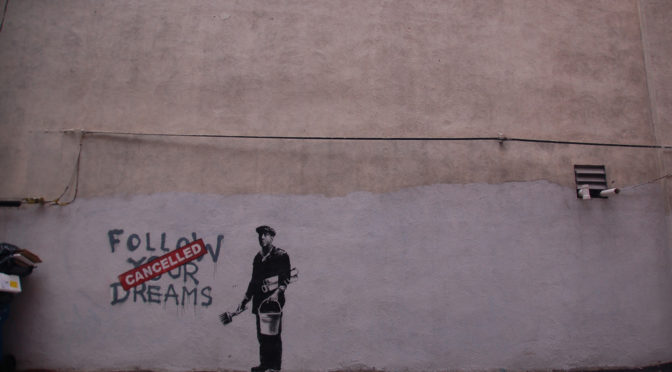
Other people say do what you love and the money will follow.
And Stephen King said the following in On Writing:
If you wrote something for which someone sent you a check, if you cashed the check and it didn’t bounce, and if you then paid the light bill with the money, I consider you talented.
King says any money makes a professional writer out of a merely competent one while people argue over quitting your day job or doing what you love until the money follows.
So which is it?
The truth is it depends. Several factors go into talking about how you derive income. Let’s start with the basic premise that it’s pretty hard to create while starving. This has been proven — if you’re in survival mode, you start to focus more on picking berries or taking down a deer. But as Emily St. John said in Station Eleven and Star Trek said before her: survival is insufficient.
At some point, the hope of your own humanity breaks through, turtle and shell, and you begin to create. That’s why we have so many novels and books these days by Sudanese refugees and Afghani war slaves and Pakistani drone strike victims: suffering, creative restrictions, gave these artists tons of fodder for the story they just had to tell. We see this represented time and again — a homeless man or a prisoner scratching their name into the chipped paint of some wall down in the holes of the earth: Lancelot lived; Lancelot was here.
So yeah, don’t literally starve, but then again, misery does love its company and company sometimes brings a book deal to the pity party. I’m not advocating prostitution here, I’m just trying to call the cards as I see them: lots of people in the publishing world seem to think of the weak and the suffering more in terms of the money their stories could generate rather than as fellow human beings that went through hell.
Be that as it may, though dire circumstances have not even deterred the Anne Franks among us, let’s say you’ve done what you can to make sure you will eat enough to keep from starving. I have a duty to do no harm here: I’m not encouraging masochism of the oblivious alcoholic or the causeless martyr or anyone in between. C.D. Wright said:
“Poetry will not go quietly. You would have to starve it out, and it can eat on very little. Hunger and love move the world, didn’t Schiller say so.”
She was speaking, I think, of the amount of money and grants and investiture we allocate for poets as well as the amount of time the culture spends thinking about poetry.
But perhaps she also meant simply how much money we poets make. I think the same can be said of novelists, though not so truly as with our poets: watch how a culture treats its poets and you will see its future. To “live on very little” in this sense is to realize that there is very, very little overhead to storytelling and wordsmithing. You need a pen and a piece of paper, some flint and a wall, a pair of vocal chords and an audience. A photographer requires his camera. A painter his pigment. A filmmaker his movie set. Not the writer. The writer finds all of humanity — indeed all of existence — gathered to him in the assembly hall of his mind. He merely calls them to order with his conductor’s baton and its inky core.
That said, since man first received the gift of consciousness and history broke forth in a sudden dawn, there existed two ways to be rich: hoard much or need little. You can live on very, very little. You can move to one of the cheapest places in the country — or, if you have next to no family or friend ties right now, you can move to one of the cheapest places in the world — grab a corner under the stairwell, a stack of paper, and a pen or a typewriter or a $25 computer made in the 90’s with some Rich Text editor installed on it. That’s all you need to begin and I encourage you to do this. This is exactly what Stephen Pressfield did after his divorce. This is essentially how Stephen King began. Both Stephens started in trailers.
ANY MONEY MAKES
A PROFESSIONAL WRITER?
I began the professional side of my writing career in Joplin, Missouri in 2010, a town where even married I could pay $400/month in rent for this 3000ft2 country house. It was the very place my wife first asked me Why don’t you write more? The community around us even then judged me for quitting my job to begin my work, but my wife knew and she told me: start your business and rest in it. I made $330 dollars that year, pre-tax, but I learned both the business and the craft. And every year since then, I’ve more-than-doubled my writing income. The plan’s to keep up the doubling pace until it’s mathematically improbable to do so any longer (humanity, and therefore my potential audience, exists in finite numbers).
That could only happen, though, because I reinvested that $330 and that time spent learning right back into my business — I bought a laser printer to save time and money in the long haul, some extra toner, and a ream of paper that would eventually have four different novels printed on both sides. All because we could pay $400/month on rent and buy the cheapest gas in the country for a car that had 200,000 miles on it and did at least 30 miles/gallon. Curious that Joplin became pretty popular after that. Joplin, for the record, is not so cheap anymore. You may want to pick Lamar or Purty, Kansas.
Let’s say you figure this piece out — how to start humble by getting comfortable with poverty. You may be working a day job still. This isn’t a bad thing. Some of my favorite short stories, or at least some of my favorite writing realizations I made while writing short stories, came into being while on night shift at Joplin now nonextistant St. John’s Hospital. A tornado nearly ranked EF6 took it down a peg or two. Literally. But I asked permission from the shift nurses if I could write on the slow nights in the nurse’s station. They said yes as long as I had all my work done for the evening and no one was buzzing and no one else needed help. Seemed fair. There was a rule at the time that you couldn’t save things on the server because it was owned by the hospital, so every night I would save my draft in Word, email it to myself from Microsoft Outlook (which I never use) to my Gmail account and would delete the document only to download it the next evening. All this in the middle of catheters and enemas and illiostomy bags and floors covered in blood and stories about constipated cripples who “shat rooster tails” out the backs of wheelchairs once relief had come. Lively environment. Tons of fodder for future stories.
That’s one of my points: as long as you make time to write, your day job will give you plenty of prima materia from real life that will work as human fodder for your characters. No one can tell a truly human tale if they go one step further than Capote and live out their whole life alone in hotel rooms.
Another point is time: if you can’t make time to write, then it’s not a priority. I don’t believe in busyness. You’re not too busy to write. You’ve simply prioritized your time in a way that doesn’t allow you to write. Take responsibility for your schedule, for crying out loud. You’re an adult. Act like one. You are not too busy to write. You simply care about other things more right now. Perhaps that reality TV show or binge-watching Daredevil or playing Call of Duty or knitting or your kids.
Knitting and kids are good. That’s the other piece of the “don’t quit your day job” bit — if you have kids or a spouse, then your top priority is being a great parent to your kids, a great spouse to your husband or wife. And that’s a beautiful thing! But realize that has financial burdens attached to it. Had it not been Tara who prompted me to quit my job, I never would have done so. It’s unfair to let your spouse shoulder all of the financial burdens of life if doing so wasn’t their idea. Doubly so for kids. They deserve the very best you can offer them.
All of that goes under a different category of art: “starting a family.”
Now you can still find time to write in the midst of that — King did and so did tons of other authors. But I want to point something out:
Your interests will be divided. If you’re young and single and really want to go at this writing thing in a serious, career-shaping, responsible kind of way, then I recommend you set aside your desire to start a family until you’re at least thirty and potentially consider a monastic or celibate lifestyle.
As the guy who assembled Fifty Reads for Writers, I can say that after reading a great many books and articles and poems on writing, I know of no one who will advise this. But it’s true. Most writers don’t have a significant breakthrough until they’ve had ten years of work. If I caught you at 19, you’ll be about 29 when you have enough momentum to break through. That’s three years after Stephen King broke through and four years before C.S. Lewis did.
Lewis is an interesting cat because he was single. In fact, so were many writers:
- C.S. Lewis
- Diane Keaton
- Bill Maher
- Henry David Thoreau
- Oprah Winfrey
- Simone de Beauvoir
- Queen Elizabeth
- Ralph Nader
…the list goes on. And if you include the number of writers who got divorced and then, in their newfound singleness, wrote their masterpiece the number is staggering.
Do not divorce for writing: you made a covenant with your spouse.
But…
If you have not yet made a covenant, it might do you better to join an intentional community or a neomonastic house to both (1) live cheaper and (2) live with whole, human relationships without the duties of family.
Which, in a really weird way, brings me to Faulkner.
Faulkner took the “don’t quit your day job” advice a bit too seriously. He also took seriously “do what you love and the money will follow.” But he knew that if he created passive income, he would have a way to survive while working on his writing. So he saved up money from his blue collar job and bought himself a brothel. Yes, he owned prostitutes. Got a lot of writing done working the front desk.
Am I tell you to own sex slaves?
Absolutely not. In fact, if it comes down to that, give up your writing and get a day job — your dream to become a good writer is predicated on the assumption that you’re a good human. You want to be a good writer, a good doctor, a good lawyer but you’re a horrible human being?
Yeah, good luck with that.
Like all people, Faulkner wasn’t all evil or all good. One of the good things we can learn from this episode of his is passive income. So perhaps you might consider becoming a landlord. Or owning dividend-paying stocks — if you own $200,000 of IBM, for instance, you can generate about $8,000 in dividends every year (and their dividends increase at a rate of about 13% annually, so that’ll be $9,000 the next year, $10,000 the third year and so on). I personally generate passive income through supporters who sent me to New York to do community development (if you’re interested in hearing about my other job, and other love, drop me a line at lanceschaubert@gmail.com). That job doesn’t quite give me a ton of free time through passive income but it is flexible in a way and requires me to write, so that has helped. I know people who do an über version of this through regular backers on places like Patreon to much success — heck, Amanda Palmer wrote a whole book about it. So patronage support can work. In fact, for all of the ills of the feudal system, it worked out pretty well for artists. Residuals from intellectual property is another form of passive income, but since we’re working towards that, it’s kind of a wash. We’ll cover this in the “creating a backlist” section of the upcoming part on “Author Earnings.”
In any case, passive income will give you space to do what you love. But just as you reinvest profits, if you reinvest time, reinvest talent, keep drilling down deep for that water of life – do what you love and the money will follow.
It’s just a matter of (1) prioritizing what it is you love and (2) creating enough space to take a loss lead compared to your peers. If you own a restaurant, your first three years will be in the red. If you start a business, Elon Musk calls it, “Staring into the void, chewing glass.” It’ll be hard for about ten years. And then you’ll see light at the end of the tunnel.
A very, very long tunnel.
But it’ll come because you will have made your first money doing what you love. And according to Stephen King, if you’ve paid an electric bill or a phone bill or a doctor bill with money you made doing what you love, then you’re a professional.
Keep doing what you love because any money makes a professional writer.
Don’t have time for the whole series?
That’s okay, I made you a…
CHEAT SHEET TO BOOK BUSINESS
Here’s our outline for upcoming posts:
- Intro
- The Gateway Drug: Poetry
- Does Fiction Lie? — The Liar’s Club
- Where and How to Sell What You Write
- From Daydreams to Written Dreams
- Rejection Slips
- Any Money Makes a Professional Writer
- Quarterly Assignments
- Making Good Money… in a shadow career
- Kinfolk and Advocates or “How to Build a Platform”
- Draconian Contracts
- Author Earnings
- Succeeding for Others
- Blaze a Trail All Your Own

cover image from Chris Devers


Comment early, comment often, keep it civil: