“Money doesn’t talk, it swears”
— Bob Dylan.
I was thinking about my days spent, a quarter-century ago in Papua New Guinea (PNG), a place that Time forgot to forget, and where, in some quarters, the Mighty Whitey hadn’t ever been seen until 1970s.
Among other things, it was a GodsMustBeCrazy kind of place, almost hallucinogenic in some ways, driven over the edge by colonial introjection; you found yourself doing double-takes a lot. And saying, “Hunh?” It was filled with colorful characters and doings, supermarkets were guarded by half-naked men with bows and arrows; locals spit out blood red betel juice that reminded me of baseball players spitting tobacco; ex-pats lived on compounds protected from ‘rascals’ by razor-wire fences; pot-holed roads left drivers vulnerable to catastrophic situations. Surreal events took place: one time rascals robbed a Port Moresby bank, tried to get away in a helicopter, had the copter shot down by police, who then killed the bandits and cut off their testicles in the smoky ruins.
But at the same time, locals were sedate and friendly; interactions easy. It was a society driven by a wantok (“one talk”) system — a tribeswoman who got a job as a secretary, say, was obligated to share her earnings with her fellow clansfolk. It was a situation which could be, in some ways, summed up with a blurb from a book of short stories, Port Moresby Mixed Doubles by Michael Challenger:
“The local inhabitants are often relegated to roles as domestic servants, subordinates at work, or as partners in brief sexual flings. Among the expatriates themselves, relations are complicated by boredom, jealousy and self-importance.”
So true.
Out of all the colorful characters I came across there none brought out the crazy melange of Das Kapital, prehistoric literality, missionary pilgrims-progressivism, and the kind of good old ingenuity that kept the chains moving on the evolutionary track: Meet Abba Bina, aka Mr. Shit.

Mr. Shit
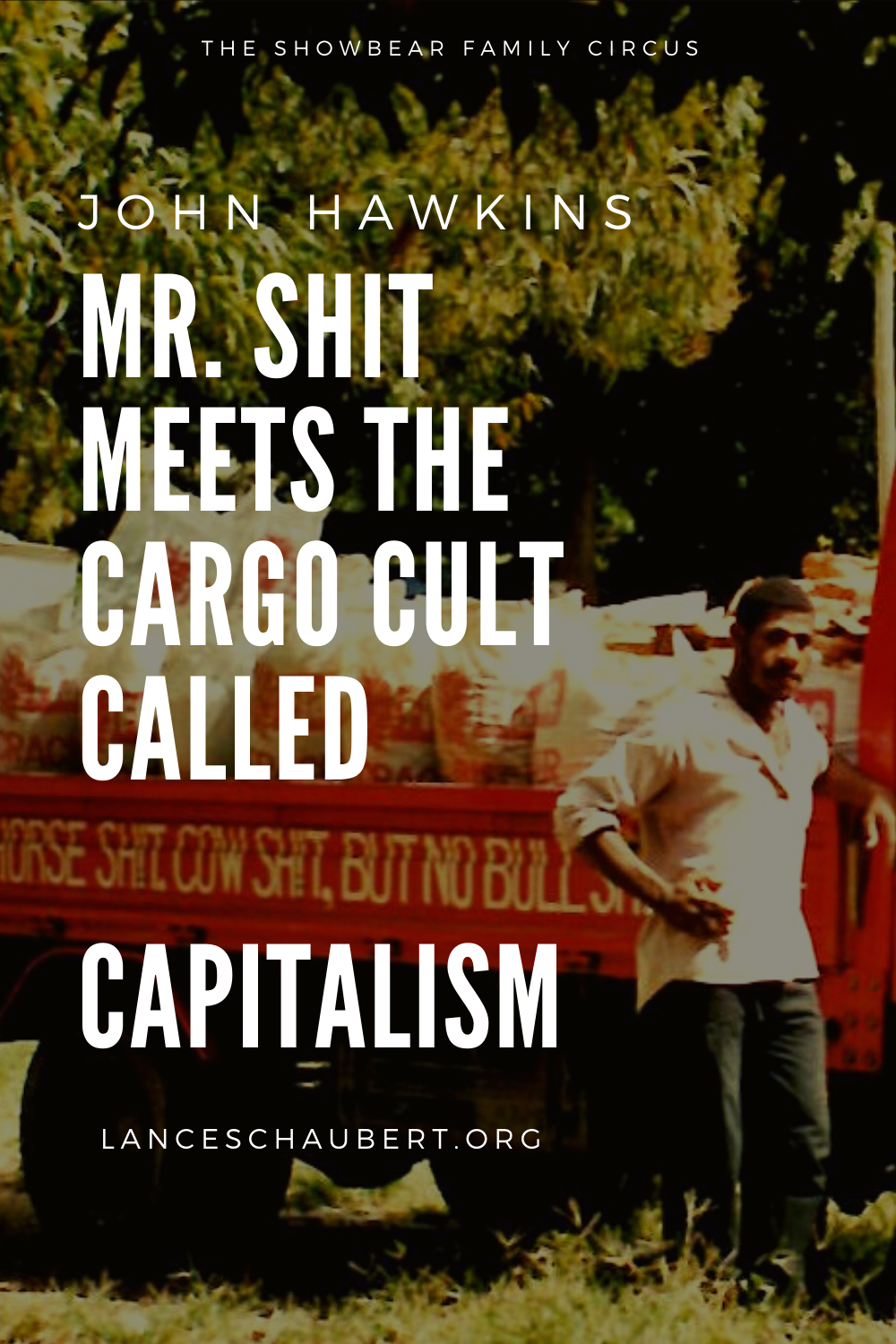
I remember Mr. Shit fondly for his proud morality motto: “Chicken shit, horse shit, cow shit, but no bullshit.” He ran for office with that slogan, and lost, because, as we all know, at the end of the day, once the charm of such populism wears off, deep down we want the bullshit.
Mr. Shit, in turn, had me thinking about another character from PNG I dealt with in a book review I wrote not long ago: Behrouz Boochani. He’s an Iranian Kurd who was chased out of Tehran, the religious regime there wanting to bust his balls (literally) for his dreaming of a future Kurdistan. Some “friend” sent him in the direction of Australia in search of refugee status and expressive freedom (apparently as some kind of practical joke, as Oz, for all its virtues, has no real protections for journalists, and struggles, occasionally, to justify it). Boochani tried to “jump the cue” by arriving in Oz by boat. But a new law stated that boat people would be detained and never allowed into Oz as refugees. He was flown to the notorious refugee center on Manus Island, off the coast of Papua New Guinea, where he languished for six years.
Boochani commenced to complain, along with other detainees, about the foul conditions of the center. Australian refugee advocates took up his cause. Somehow, he managed to find a way to smuggle not one, but three mobile phones into the Manus Island prison, which, because I’m twisted, made me think of the scene in Pulp Fiction when young Butch is delivered a family heirloom. He kept a steady flow of encrypted complaints going to an advocate in Australia by way of WhatsApp (the center had wi-fi) and the complaints were duly noted.
Being on Manus Island meant dealing with the locals, who provided much of the low-level maintenance and served as guards, at lowly wages. They didn’t want the asylum-seekers in their community after a while. There were riots and deaths. Manusians were resentful at having no say in details worked out by PNG and Australians miles and miles away. “The imprisoned refugees feel that they are in a nightmare; their feelings about the locals are transformed into a nightmare,” Boochani wrote. Colonized, the locals had an odd presence, tribal instincts married to a rustic Australian humor gone feral, almost phantasmagorical.
Anyway, Boochani won Australia’s top literary prize with his book of smuggled grievances against Australian migration policy and the conditions at Manus. In the the book, detainees said that they had to slosh and smell through ankle-deep turds in “cremation” hot heat that Boochani rightly describes as torture. The water pump in the toilet-house didn’t work and no one knew if it was the vandals who took the handles, or hwat. Boochani’s trials and tribulations — vis-a-vis his waste treatment by Aussie policy — are over. The cause célèbre has been sent into the loving arms of the New Zealand people, a free man, in transition to a future life in America (a place he had previously said he wouldn’t go to unless he was given the opportunity to sue Australia for his ‘torture’ at Manus.) He continues to tweet his doings.
In the course of my research, I wondered about the local scene, how Australia had contracted with PNG to set up the detention and later “residential” facilities for the asylum-seekers. Apparently, the asylum-seekers had plenty of sympathy from the locals when they first arrived in 2013 (I’ve seen happy-faced testaments) and the good missionary work of a charitable heart seemed on full display. But then I discovered ka-ching was a factor and that other kinds of missionary work was going on, probably at reasonable rates for the refugees but at great cost to the local colonized community: Brothels to service the asylum-seekers.
Well, the argument for brothels was not so much a matter of providing comfort to the stateless prisoners, but rather seemed, if I read right, to be along the lines of providing a good wage for the island girls and, apparently, wives. But the idea was rejected because, being a community that has absorbed the invader ethos, locals can’t open up a shop referred to as a “brothel,” but instead provide the same services in facilities called “massage parlors, bars, strip clubs, body rub parlors, and studios or by some other description.” Wham. And then it hits you, the colonial corruption at work and play, Big Mammon™ spreading its seed. You can see it in the way they dress, the crossover, and it reminds you of “horrors” you’ve seen elsewhere.
And the shit keeps coming, overflowing really, like Boochani’s depicted toilet room. Australia has spent more than $10 billion on the “offshore processing” of asylum-seekers, according to a Unicef report, from 2013-2017.
After the detention center closed and detainees were moved into other encampments on the island, Australia hired, without a bid, a shady mercenary company called Paladin who were handed $423 million dollars to service the asylum-seekers, but accounting giant KPMG, in a report through the Australian Financial Review, can’t seem to figure out what the company was actually paid for: “One issue is the sheer amount of money being spent – $1600 a day for each refugee, not including food or medical care, when comparable mining camps in PNG provide far more services for around $100 a day.” Where does this money go?
But back to the locals, who are the neglected lot in this sordid tale. It turns out, the brothel idea may be a kind of control valve to help contain some ‘hyper-active refugees’. Because there has been a pregnancy problem in the community; refugees hooking up with local women and having kids together. When father refugees are removed from PNG, they leave behind women who will bear children who will be seen as second-class citizens in the local patrilineal culture. In effect, the refugee fathers could leave these women — and children — homeless. That takes awhile to settle in.
Manusians have no say on these state-to-state issues: Australian politicians meet with PNG politicians, talk cash payments, and essentially set the agenda for things that will happen on Manus Island (and elsewhere in PNG). Now that Americans have decided to challenge the Chinese in the region in a war of doctrines, Project for a New American Century (think John Bolton) versus the Asian Century, the refugee detention center has been torn down and room made for the refurbishing of a joint Australia-US naval base to stop the spread of the Red Menace (or is it the Yellow Peril?) in the South Pacific. The Commies seem to be tweaking the noses of the Capitalists.
The Manus base will cost billions of dollars. A Chinese mining company is already set up on the opposite end of the island. With Americans coming, those brothels — er, massage parlors — will come in handy. The locals caught in the middle again. On the other hand, back to that GodsMustBeCrazy meme, colonialism has spawned a weird kind of cargo cult worship of the American military, reminiscent of the scene in Apocalypse Now. It remains to be seen if any Yanks will end up going ‘el tropo’ (as they do in the film) from the experience.
More recently, Prime Minister James Marape declared that Manus Island will become a Tax-Free Haven. More money pouring into Manus Island. The locals, living on short pay, like servants looking for tips. Or as The Big Smoke has it, “To prove that irony is dead, and perhaps pointing to the fact that we’re living in a dystopia, the Papuan government has this morning announced that Manus Island is set to become a corporate tax-free zone.” Islanders will gain the privilege of being prostituted in new ways. Again, no local input.
This is the way it has always been with money — all the way up to Mr. Shit and beyond. Manus Island: manus manum lavat: one hand washes the other. No hands are clean.


Comment early, comment often, keep it civil: